
Most US small businesses that hire a digital marketing agency in 2026 pay a monthly retainer somewhere between roughly $1,500 and $5,000, and any agency quoting under $500 a month for SEO is "selling a service that cannot deliver results" (DigitalApplied, 2026). The dollar figure is where everyone starts negotiating. It is also the least useful number in the whole proposal.
Short answer: In 2026, most US small businesses pay a digital marketing agency a monthly retainer between about $1,500 and $5,000 - the entry-to-basic tier for legitimate SEO and marketing work (DigitalApplied, 2026). PPC management typically runs 10-20% of your ad spend, or a flat fee of roughly $1,500-$5,000/mo under about $10,000/mo in spend (Bridgeway Digital, 2026). Hourly work spans roughly $75-$400+/hr, with a worldwide agency average near $138/hr (Credo, 2019 survey). The pricing model you choose - retainer, project, or performance-based - matters more than the headline number, because it decides who absorbs the risk when scope changes.
What agencies actually charge in 2026 (the honest ranges)
Pricing follows scope and market competitiveness, not your zip code. With that caveat, here is the honest lay of the land for 2026.
Monthly retainers cluster into recognizable tiers. Entry-level and local single-location work starts around $1,500-$3,000/mo; mid-market engagements run $3,000-$7,500/mo; advanced, competitive campaigns land at $7,500-$15,000/mo; and enterprise programs run $15,000-$50,000+/mo (DigitalApplied, 2026). Retainers remain the backbone of the business: 61% of agency engagements now use a monthly-retainer model (DigitalApplied, 2026), and in an older but widely cited industry survey, 98.79% of agencies said they offer retainers at all (Credo, 2019 survey).
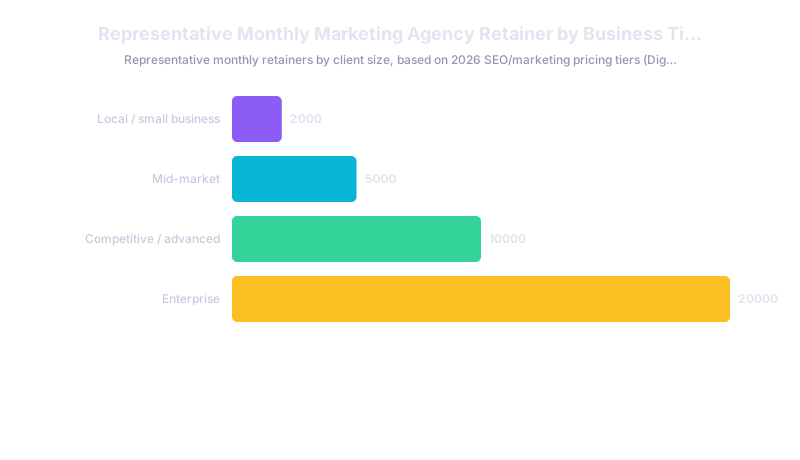
Hourly rates span a wide band - roughly $75-$125/hr for junior analysts up to $250-$500/hr for enterprise consultants (DigitalApplied, 2026) - and the worldwide average agency rate came in at about $138/hr ($137.94 for agencies specifically) in Credo's industry pricing survey (Credo, 2019 survey; treat as a directional benchmark, not a 2026 figure).
The one number that should make you walk away is anything under $500/mo dressed up as "SEO." At that price an agency can only put two or three hours a month against an account that realistically needs 15-40, which is why it is "selling a service that cannot deliver results" (DigitalApplied, 2026). Cheap almost always means outsourced, templated, or simply not being done.
The pricing models, decoded
Agencies package the same work under a handful of billing structures. Knowing which one you are being quoted tells you who carries the risk.
- Hourly / time-and-materials. Transparent and easy to audit, but it quietly penalizes efficiency - the faster and better the agency gets, the less it earns. It is fading as clients push back on paying for hours instead of outcomes.
- Monthly retainer. The dominant model, used in 61% of engagements (DigitalApplied, 2026). You buy a fixed block of ongoing work each month. Best for continuous disciplines like SEO, PPC, and content where momentum compounds.
- Project-based flat fee. A single price for a defined deliverable - a website build, a campaign launch, a technical audit. It caps scope, which protects you, but anything outside the statement of work becomes a change order.
- Performance / value-based. Cost is tied to leads, revenue, or economic value created. Attractive on paper, but only as trustworthy as the tracking and attribution behind it.
- Hybrid (base retainer + performance). A smaller guaranteed retainer plus an upside tied to results. It is the structure gaining the most ground heading into 2026 because it splits the risk between both sides.
PPC pricing: why 10-20% of ad spend is the anchor
Pay-per-click is priced differently from most services because the workload scales with the budget. More spend means more campaigns, more keywords, more creative, and more testing to manage.
Above roughly $10,000/mo in ad spend, the percentage-of-spend model takes over, "often around 10% to 20%" of your monthly budget (Bridgeway Digital, 2026). The worked example is simple: "if your monthly ad budget is $30,000 and the agency charges 12%, your PPC management fees are $3,600" (Bridgeway Digital, 2026).
Below about $10,000/mo, a flat monthly retainer is usually the cleaner option, with a "typical range: $1,500 to $5,000 per month" (Bridgeway Digital, 2026). For accounts in the $10K-$30K/mo spend range, expect roughly $2,000-$5,000/month in management fees under either model (Bridgeway Digital, 2026).
One thing to watch: platform and ad-tech fees can be stacked on top of the management fee. Always ask whether the percentage you are quoted is the total cost of management or just the agency's cut before the tooling.
Agency vs. in-house: the real cost comparison
The instinct to "just hire someone" underestimates what a functional marketing team actually costs. A single SEO Specialist averages about $86,000/yr, and a Head of SEO runs roughly $182,000/yr in the US (Glassdoor, 2026) - and that is base salary before benefits, payroll taxes, software, and the other specialists a real program needs.
By the time you fully load a small in-house team - a strategist, a specialist or two, and the tool stack they run on - you are realistically looking at low-to-mid six figures per year. (That fully loaded figure is our illustrative estimate, not a sourced survey number; the individual salaries above are from Glassdoor's 2026 data.) Against that, a $3,000-$5,000/mo agency retainer buys an entire skill stack - strategy, execution, and tooling - for a fraction of the cost of one senior hire.
In-house still wins in specific situations: when your volume is high enough to keep specialists fully utilized, when the work depends on proprietary product knowledge, or when marketing is the core of the business model rather than a support function. For most local and growing SMBs, the retainer math wins.
What drives your price up (and the GEO factor)
Two businesses in the same city can get quotes that differ by 3x. The biggest multiplier is competitiveness - how hard your market and target keywords are to win. A plumber in a rural county and a personal-injury firm in a major metro are not buying the same amount of work, even if the service list looks identical. Regulated verticals like legal and healthcare (including med spas) command a premium for the same reason.
The fastest-rising legitimate line item in 2026 is optimizing for AI search - GEO/AEO, or getting your brand named inside ChatGPT, Perplexity, and Google's AI Overviews. The reason it is worth a separate budget: in an Ahrefs study of 75,000 brands, branded web mentions correlated with AI Overview visibility at 0.664, versus just 0.218 for backlinks - roughly a threefold-stronger signal (Ahrefs, May 2025). Brands in the top quartile for web mentions averaged 169 AI Overview mentions against just 14 for the next quartile down, about a tenfold difference (Ahrefs, May 2025). In other words, the off-site brand presence that AI engines reward is a different, and often more expensive, discipline than traditional link building. For how AI search and traditional channels compare, see our guide to Google Ads vs. SEO for local business.
Red flags and questions to ask before you sign
The proposals that cost you money rarely look cheap - they look vague. Watch for a retainer with no defined deliverables, no reporting cadence, or a "we do everything" package that never says which channel actually gets your budget. A $2,500 retainer with a written scope and monthly reporting beats a $1,200 "everything" package that quietly spends your money on whatever is easiest to bill.
Before you sign, get straight answers to five questions:
- What exactly is included each month, in writing?
- Who does the work - in-house staff, or outsourced contractors?
- What is the exit term and notice period?
- How is success measured, and how often is it reported?
- Are there fees on top of the retainer (ad platform, tools, third-party licenses)?
What This Means for Your Business
Budget the model, not just the number. Match a retainer, project fee, or performance deal to your actual goal, and remember that the structure decides who absorbs the risk when scope shifts. For most local and growing SMBs, $1,500-$5,000/mo buys legitimate, needle-moving work - but only when it comes with a defined scope and measurable outcomes. Anything under $500/mo almost never moves rankings, and a vague "everything" package at any price usually means no one is accountable for the channel that matters to you.
Before you sign anything, insist on written scope, a reporting cadence, and a clear definition of success. That single discipline separates the retainers that pay for themselves from the ones that quietly drain your budget. See how much a business like yours should be spending overall in our companion guide, how much a small business should spend on digital marketing in 2026, and the full in-house marketing vs. agency cost comparison.
Get a transparent, scoped quote - no vague "we do everything" packages. See how Semark prices digital marketing at /services/digital-marketing-ads, or book a free scoping call at /contact.
CONTENT