
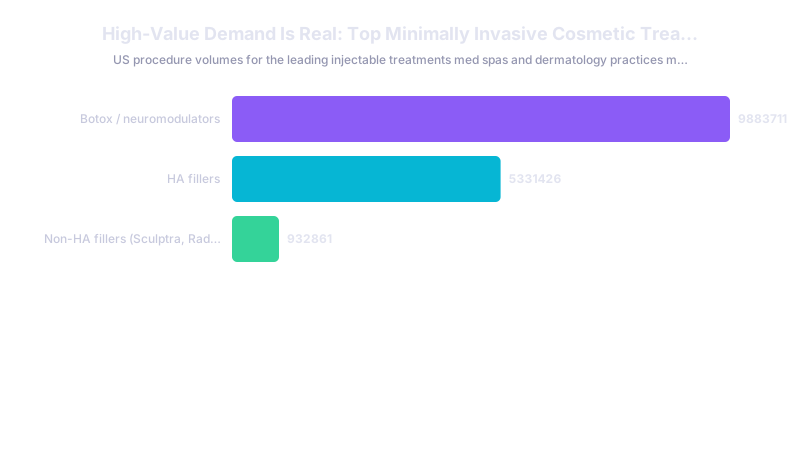
Americans underwent 9,883,711 botulinum toxin (Botox and other neuromodulator) treatments and 5,331,426 hyaluronic-acid filler treatments in 2024 (American Society of Plastic Surgeons, 2024). The demand for high-ticket cosmetic work is enormous and repeat-driven - but for dermatology practices and med spas, the hard part is not the demand. It is being the practice a prospective patient trusts enough to book, without violating the HIPAA and FTC rules that govern how you advertise medical treatments.
Short answer: To market high-value cosmetic procedures, a dermatology practice or med spa needs three things working together: a review engine (Alex Thiersch of the American Med Spa Association calls reviews and testimonials "the best med spa marketing tools you can ask for"), compliant before/after galleries that treat every image as HIPAA-protected health information requiring separate written marketing authorization, and treatment-specific pages that name each procedure buyers are actively searching for. The demand is real and high-ticket - 9.9 million Botox/neuromodulator and 5.3 million HA-filler treatments in 2024 (ASPS) - so the practice that ranks, earns trust, and stays compliant is the one that captures it.
Why high-value procedures need a different marketing playbook
Cosmetic demand is large, recurring, and resilient. Beyond the injectables above, non-HA fillers such as Sculptra and Radiesse accounted for another 932,861 treatments, part of more than 28.5 million total minimally invasive procedures in 2024 (ASPS). ASPS president Scott Hollenbeck, MD, noted that "patients continued to prioritize their aesthetic health in 2024 despite the unpredictable economic uncertainty they faced throughout the year."
That demand fuels a substantial industry. The US medical aesthetics market "has eclipsed $17 billion and is growing by more than $1 billion per year" (American Med Spa Association). Globally, Grand View Research valued the medical spa market at roughly $24.2 billion in 2025 and projects a 15.9% CAGR to about $78.2 billion by 2033.
Here is what that means for your marketing: a Botox patient does not come once. Injectables wear off in three to four months, so a satisfied first-timer is worth years of repeat revenue. That lifetime value justifies a real acquisition budget - but only if you win on trust. A patient choosing where to inject their face behaves like someone choosing a surgeon. They research the provider, not the price. Discounts and Groupon-style promotions mostly train price-shoppers who never return; trust signals drive the booking.
Reviews are the deciding trust signal - build a system, not luck
Ask any med spa what tips a browser into a booking and the answer is social proof. "The best med spa marketing tools you can ask for are reviews and testimonials from existing patients," writes AmSpa founder Alex R. Thiersch, JD. The data backs him up: 72% of consumers say positive reviews make them trust a local business more (Experian, cited by AmSpa).
The mistake practices make is treating reviews as something that just happens. It should be an operational system. Thiersch recommends a documented protocol - designate front-desk staff as gatekeepers who ask satisfied patients for a review before they leave, track which team members bring them in, and reward top performers. A deep base of positive reviews keeps any single complaint from standing out. For the full workflow, see our guide on how to get more five-star reviews for your service business.
Before/after photos: your best conversion asset and your biggest compliance risk
Nothing sells a cosmetic procedure like a real result. But before/after photos are also where practices get into legal trouble, because those images are Protected Health Information under HIPAA - even for cash-pay cosmetic patients. As health-care law firm ByrdAdatto explains, photos showing "full-face images, tattoos, scars, birthmarks, or other unique identifiers can be considered PHI," and using them for marketing "require[s] written patient authorization" that is separate from treatment consent.
Get the authorization right before a single image goes live. It must specify who may use the images, where (a website release does not automatically cover social media), how, for how long, and the patient's right to revoke. Store images in your encrypted EMR - even confirming online that someone is a patient can breach HIPAA.
Then layer on FTC truth-in-advertising standards. Any claim, express or implied, must be substantiated; results that are not typical need clear disclaimers; and you cannot use misleading editing or filters to exaggerate outcomes. Compliance guidance from MedMind Marketing calls missing or improper before/after disclaimers and authorizations the single most common violation it sees. Treat these photos as a compliance liability that happens to convert - because one HIPAA or FTC misstep costs more than any campaign earns.
Get found for the exact procedure people are searching
People do not search "med spa." They search "lip filler near me" or "laser resurfacing cost." Build a dedicated, optimized page for each of your highest-margin procedures - Botox, lip filler, laser resurfacing, microneedling - rather than burying them all on one generic "services" page. Then optimize your Google Business Profile and local listings, because this is a proximity-driven local purchase.
Increasingly, that discovery runs through AI answers, and the ranking signals differ from classic SEO. In a study of roughly 75,000 brands, Ahrefs found brand web mentions correlate with AI Overview visibility at 0.664 versus just 0.218 for backlinks; the most-mentioned brands averaged about 169 AI Overview mentions versus 14 for the next quartile down (Ahrefs, 2025). So earning press, directory, and community mentions matters more than another link-building sprint. On-page, controlled research on generative engine optimization found that citing sources, adding statistics, and adding quotations lifted content visibility by up to about 40% (Aggarwal et al., KDD 2024) - though those figures come from a synthetic academic benchmark, not proven on local-business queries, so treat them as directional. Our guide to optimizing for Google AI Overviews walks through the tactics.
What This Means for Your Business
- Pick your 3-5 highest-margin procedures and give each its own optimized page naming the treatment buyers search for.
- Stand up a review-collection protocol this month - a documented, accountable system, not an afterthought. See more med spa marketing ideas to attract new clients.
- Get before/after authorizations right before you post a single image. Separate written marketing authorization, specifying images, platforms, duration, and revocation rights.
- Track cost per booked appointment, not cost per lead, and reinvest against the lifetime value of a repeat injectable patient.
- Win on trust infrastructure, not discounts - because a cosmetic buyer choosing where to inject their face behaves like someone choosing a surgeon.
CONTENT
