
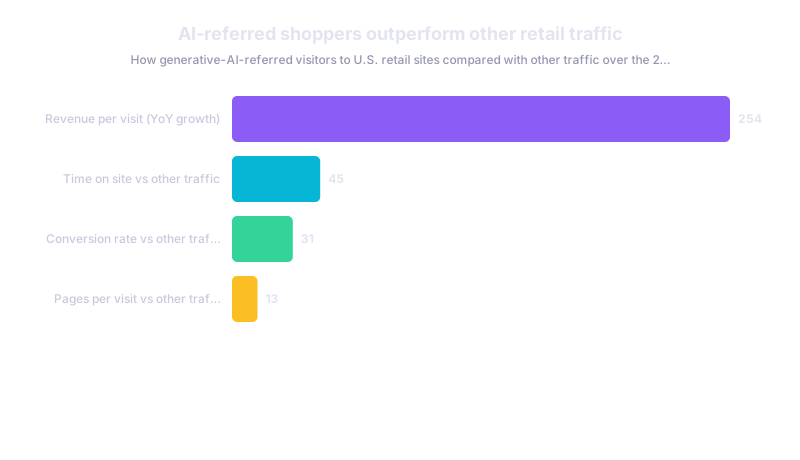
Traffic to U.S. retail sites from generative AI sources rose about 693% year-over-year across the 2025 holiday season, and those AI-referred shoppers converted 31% more than visitors from other traffic sources (Adobe Analytics via Digital Commerce 360, 2026). AI shopping is no longer a novelty channel you can ignore.
Short answer: To get your products into ChatGPT and other AI shopping answers, submit a clean, structured product feed - automatically if you sell on Shopify or Etsy, or directly through OpenAI's Agentic Commerce Protocol - because ChatGPT treats the merchant feed as its source of truth for price, availability, and attributes. Then reinforce it with accurate on-page Product, Offer, and AggregateRating schema, real review data (star ratings and review counts), and third-party brand mentions across the web. Product placement in ChatGPT is organic and cannot be bought (OpenAI, 2026), so feed completeness, review signals, and off-site brand footprint are what actually decide whether you show up.
Why AI shopping answers now matter for ecommerce
ChatGPT passed 800 million weekly active users, a number CEO Sam Altman announced at OpenAI's DevDay in October 2025 (TechCrunch, 2025). A meaningful and growing slice of those people now ask it what to buy - and the commercial signals are strong. Over the 2025 holiday season, Adobe Analytics found that AI-referred retail visitors didn't just show up in bigger numbers; they behaved better once they arrived. They bounced 33% less often, spent 45% more time on site, and viewed 13% more pages per visit than other traffic, driving revenue per visit up 254% year-over-year (Adobe Analytics via Digital Commerce 360, 2026).
The practical takeaway: AI shopping is largely upper-funnel discovery. People use it to research, compare, and narrow options - and the purchase often lands somewhere else. That reality should shape both how you optimize for it and how you measure it.
How ChatGPT actually picks products
ChatGPT assembles a shopping answer from three inputs: the structured merchant feed you submit through the Agentic Commerce Protocol (ACP), its reading of your live product and category pages, and its sense of your brand from the rest of the web. The feed is the authoritative record - it's the source of truth for price, stock, and attributes, not a live crawl of your site.
Two things matter most here. First, placement is organic. OpenAI states these results are unsponsored, chosen on relevance, and cannot be bought (OpenAI, 2026) - there is no ad slot to purchase your way into the recommendation set. Second, if you sell on Shopify or Etsy, your catalog is already integrated for ChatGPT discovery with no separate application needed. For many small merchants, eligibility is already handled; the work is making sure the data is clean.
Get your product feed right first
Because the feed is authoritative, feed hygiene is the highest-leverage work you can do. OpenAI's ACP products spec lists a clear set of required fields: item_id, title, description, url, brand, image_url, price, availability, and seller details (seller_name, seller_url), plus eligibility flags (OpenAI Developers, 2026). Miss these and your product simply can't be represented properly.
Then there are the recommended, high-impact fields - star_rating, review_count, reviews, variant data, and Q&A content (OpenAI Developers, 2026). These are where average listings separate from complete ones.
As John Morabito, VP of SEO at Stella Rising, puts it: "The feed isn't just another signal. It's a primary authority on your brand and products." Two rules follow from that:
- Keep feed price and availability in sync with your live product page. A stale feed that disagrees with your PDP is the quiet way products get dropped.
- Use the full description length and write for clarity, not keyword stuffing. Truncating a field leaves relevance on the table.
Make your product pages machine-readable
Your feed is the source of truth, but your pages still matter - they corroborate the feed and feed the model's understanding of context. Add Product, Offer, and AggregateRating JSON-LD schema that matches your feed exactly, allow AI crawlers such as OAI-SearchBot, and server-side render your product content so it's readable without executing JavaScript.
On the content itself, the academic evidence points in one direction. In the "GEO: Generative Engine Optimization" study (Aggarwal et al., ACM KDD 2024), tactics like adding relevant quotations, statistics, and cited sources boosted a page's visibility in generative-engine responses by up to 40%, with quotation-rich content the single strongest method. In the same benchmark, keyword stuffing reduced visibility. Keep the "up to" hedge in mind: these figures come from a synthetic academic benchmark (GEO-bench), not from proven ecommerce or shopping queries - treat them as directional, not a guarantee.
Reviews and brand mentions are the tiebreaker
When several products fit a buyer's intent equally well, review data and off-site reputation break the tie. That's why star_rating and review_count are explicitly recommended feed fields (OpenAI Developers, 2026) - real review signals give the model real-world context for matching a product to what a shopper actually asked for.
Off-site presence matters just as much. Ahrefs' study of 75,000 brands found that web mentions of a brand correlated with AI visibility at 0.664, far higher than backlinks at 0.218 (Ahrefs, 2025). In plain terms: being talked about across editorial roundups, marketplace ratings, and forums moves the needle more than link-building alone. All of it feeds the model's judgment about which brands to trust.
This is also why our advice differs from most "get into ChatGPT" playbooks: feed hygiene plus genuine review data beats every clever GEO hack. Get the fundamentals right before chasing exotic tactics. For the bigger picture, see our guide on how ChatGPT chooses which businesses to recommend and our primer on generative engine optimization for small businesses.
The traffic often converts somewhere else, so measure accordingly
Here's the trap that makes businesses kill a channel they shouldn't. Similarweb found that shopping journeys which start in ChatGPT and end in a purchase happen about 5x more often through other channels - Google, retailer search, marketplaces - than via a direct ChatGPT-to-retailer click (Similarweb, 2025). The intent data explains why: 38% of ChatGPT shopping queries are interest-stage, 24% are consideration, and only 11% are evaluation or deal-hunting (Similarweb, 2025). Most of the traffic is people early in the journey.
If you grade AI shopping by last-click revenue alone, it will always look weak - and you'll cut off top-of-funnel demand you can't see in your reports. Instead, watch for lift in branded search and direct traffic, and treat ChatGPT as demand generation, not a bottom-funnel sales channel.
What This Means for Your Business
If you're on Shopify or Etsy, you're likely already eligible for ChatGPT product discovery - so the job isn't getting in, it's making sure your data earns the placement. Audit your feed and schema now. Prioritize feed completeness and real review data before chasing niche GEO tricks. Above all, fix the price, availability, and attribute mismatches between your feed and your live pages, because those quiet discrepancies are what get products excluded. And when you measure results, don't judge the channel by last-click - the payoff usually shows up as branded search and direct-traffic lift.
If you're building a store from scratch, our walkthrough on getting your first 100 sales on a Shopify store covers the groundwork first.
Want your products showing up when shoppers ask ChatGPT what to buy? Semark can audit your product feed, schema, and review signals for AI shopping visibility - start with our ecommerce marketing services or book a review.