
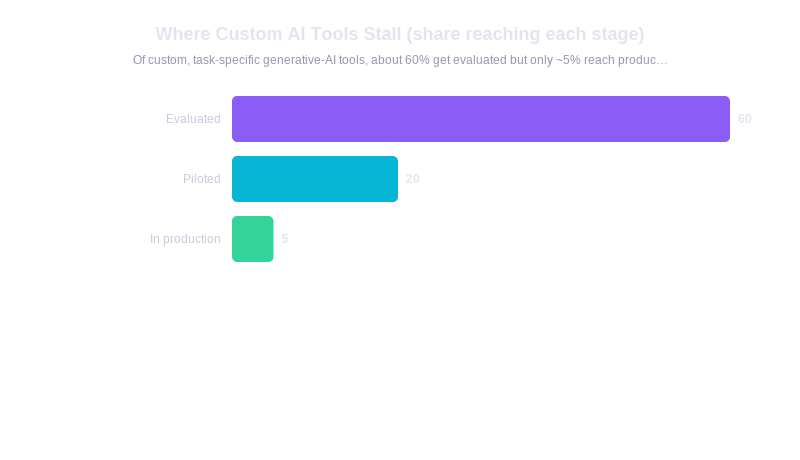
Roughly 60% of custom generative-AI tools get evaluated, but only about 5% ever reach production (MIT Project NANDA, "State of AI in Business 2025"). The gap between those two numbers is where most business AI projects quietly die, and it usually comes down to one skipped step: nobody set up a real way to tell whether the AI was any good.
Short answer: An "eval" is just a repeatable test that scores your AI's answers against examples you have already decided are correct. You build a "golden set" (a fixed answer key of real questions and the responses you would accept), you run your AI against it, and you re-run it every time something changes so you catch quality drops before your customers do. You do not need to be an engineer to do this. You need to be the person who knows what a right answer looks like.
Why "it seems fine" is not a plan
When a chatbot or AI assistant gets demoed, it almost always looks great. Someone types three friendly questions, gets three polished answers, and everyone nods. Then it goes live, a real customer asks something weird, and it confidently invents a refund policy you never had.
This is exactly the trap the data points to. Only about 20% of US businesses are using AI at all (US Census Bureau, Business Trends and Outlook Survey, May 2026), and adoption is far lower at small firms, under 20% for companies with four or fewer employees, versus 37% for firms with 250 or more employees. The businesses that succeed are not the ones with the fanciest models. They are the ones who checked their work. As LLM evaluation instructor Hamel Husain puts it, "Error analysis is the most important activity in evals."
Even among big enterprises with real budgets, the return is mostly about efficiency, not magic: 66% report productivity and efficiency gains, but only 20% are already growing revenue from AI, while 74% are still hoping to (Deloitte, "State of AI in the Enterprise," 2026). Evals are how you find out which bucket you are actually in.
Evals in plain English: three words worth knowing
Golden set. This is your answer key. Collect 30 to 100 real questions your customers actually ask, then write down (or approve) the answer you would be happy to send. Include the easy ones, but be sure to include the tricky, embarrassing, and edge-case ones, the questions that would cost you money or trust if the AI got them wrong. This set does not change often, which is the point: it is the fixed ruler you measure against.
Eval (evaluation). Running your AI against that golden set and scoring each answer. Some scoring is simple and objective, "did it include the correct store hours?" or "did it refuse to give medical advice?" Those are cheap and reliable. Fuzzier judgments ("was the tone professional?") are harder and more expensive to score consistently, so save them for the things that genuinely matter.
Regression test. A regression is when something that used to work breaks. A regression test just means re-running your golden set every time you change the prompt, switch models, or update your knowledge base, so you notice the breakage before your customers do. Husain's advice to teams is refreshingly non-technical: "When you fix an issue, show how the error rate for that specific problem went down."
The one habit that beats every fancy metric
Many vendors will try to sell you a dashboard full of generic quality scores. Practitioners who do this for a living are blunt about how little those are worth. "Generic evaluation metrics are everywhere," Husain writes. "These metrics measure abstract qualities that may not matter for your use case. Good scores on them don't mean your system works."
The habit that actually works is embarrassingly low-tech: read the transcripts. Husain's guidance is to "start by doing the error analysis yourself. Look at 50 to 100 real user conversations and find the most common ways the product is failing." You sort those failures into buckets ("made up a policy," "wrong hours," "rude tone"), count how often each one happens, and fix the biggest bucket first. That counting is your first eval. It requires a spreadsheet and an afternoon, not a data science team.
This is also how you win internal buy-in without jargon. As Husain notes, "Don't try to sell your team on 'evals.' Instead, show them what you find when you look at the data." One page of real, wrong answers your AI gave to real customers is more persuasive than any benchmark.
A simple starting workflow
- Collect 30 to 50 real questions from your inbox, phone logs, or chat history, including the awkward ones.
- Write the answer you'd accept for each. This is your golden set.
- Run them through your AI and mark each answer pass or fail, with a one-line note on why it failed.
- Count the failure types. Fix the most common or most costly one.
- Re-run the whole set after every change. If a fix breaks two other answers, you will see it immediately.
What This Means for Your Business
You do not need to understand how a language model works to know whether yours is doing a good job. You need an answer key, an honest afternoon reading transcripts, and the discipline to re-test after every change. That single practice is the difference between the ~5% of custom AI projects that reach production and the 60% that stall at evaluation (MIT Project NANDA, 2025). Start small: 30 real questions, the answers you'd accept, and a running tally of what breaks. The businesses getting real efficiency gains from AI are not smarter, they are just the ones who checked.
If you want help building a golden set for your use case, choosing between tools with an honest side-by-side test, or setting up a lightweight regression check so quality never quietly slips, that is exactly the kind of grounded work we do. Learn more about our AI and machine learning services, or get in touch and we will help you figure out whether your AI is actually any good.