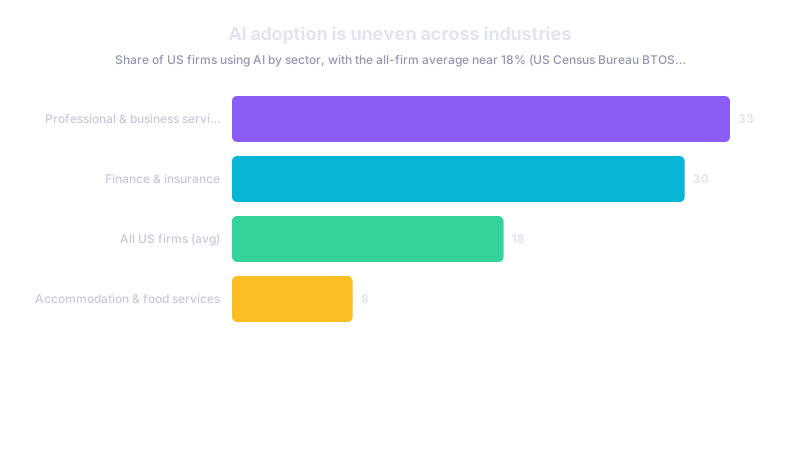
Fewer than 20% of the smallest US firms (four or fewer employees) use AI, compared with 37% of firms with 250 or more employees (US Census Bureau, 2026). Almost every small business in that group rents its AI from a vendor rather than building it - which means a contract you likely clicked through, not your own intentions, decides who owns the model, your data, and everything the tool produces.
Short answer: You almost never own the AI model itself - you license it. Under good vendor terms you keep ownership of the data you put in and the output you get back, and the vendor agrees not to train its models on your content. But "owning" AI output carries a catch: the US Copyright Office has concluded that purely AI-generated material is not protected by copyright (US Copyright Office, 2025), so owning something does not always mean you can stop a competitor from using an identical version of it.
"Ownership" is really three separate questions
When a contract talks about ownership, it is quietly bundling three different things that get handled in three different ways:
- The model - the underlying AI system.
- The data - what you type in (inputs), what the tool returns (outputs), and whether either can be used to improve the vendor's product.
- The intellectual property - whether you can legally stop other people from copying the output.
You license the model - you don't own it
For nearly all small and mid-market businesses, the model is not on the table. You are renting access to a system the vendor built and continues to control, the same way you rent Microsoft 365 rather than owning Windows. Even at the enterprise level the market has shifted decisively toward buying rather than building: 76% of enterprise AI use cases were purchased from vendors in 2025, up from roughly half a year earlier (Menlo Ventures, 2025). For a local business, "owning the model" is almost never realistic or necessary - what matters is the terms under which you use it and whether you can leave.
That makes the license your real product. Read it for what happens when the relationship ends: Can you export your data? In what format? How long does the vendor keep it after you cancel? A clause promising data return and deletion on termination is worth more to a small business than any abstract claim of ownership. (For a plain-language comparison of buying versus hiring for these jobs, see our guide on AI versus hiring an employee.)
Your data: the clause that actually matters is training
Here the contract does real work, and good vendors now say so plainly. Anthropic's commercial terms, for example, state that the customer "retains all rights to its Inputs" and "owns its Outputs," that Anthropic "assigns to Customer its right, title and interest (if any) in and to Outputs," and - the line to look for - that "Anthropic may not train models on Customer Content from Services" (Anthropic Commercial Terms, 2026). Other major providers publish comparable output-ownership language in their business and enterprise terms.
That last point is the one to hunt for in any AI contract. Consumer and free tiers frequently reserve the right to use what you type to improve the product; paid business, enterprise, and API tiers frequently do not. If you are feeding a tool customer records, pricing, or anything confidential, the difference between "we may train on your data" and "we will not train on your data" is the whole ballgame. Never assume the paid behavior applies to the free plan you tested. This matters even more in regulated fields - see our overview for the legal industry and any healthcare context where confidentiality is a legal duty, not a preference.
"You own the output" comes with an asterisk
This is where most business owners are caught off guard. A contract can hand you every right the vendor has in the output - and you can still be unable to stop anyone from copying it. In its 2025 report on copyrightability, the US Copyright Office concluded that purely AI-generated material created by entering prompts is not copyrightable, and that "prompts alone do not provide sufficient human control" to make the user the author (US Copyright Office, 2025).
In plain terms: if your team types a prompt and publishes whatever the AI produces essentially unchanged, that text or image may have no copyright at all - yours or anyone's. Contractual "ownership" of a thing that carries no copyright does not give you exclusivity. The Copyright Office was also clear on the way back: a "sufficiently creative selection, arrangement, or modification of AI output may be copyrightable," with protection limited to the human-contributed parts (US Copyright Office, 2025). Human editing and judgment are what convert a raw AI draft into something you can protect. If competitive differentiation matters, that is a workflow decision, not just a contract clause.
Portability and lock-in, kept in proportion
Vendors and consultants sometimes warn that the prompts and configurations you accumulate create deep "lock-in." Treat that framing skeptically - a well-written prompt is not a proprietary asset chaining you to one vendor, and prompts port between comparable tools with modest rework. Real switching costs come from concrete, checkable places: whether you can export your data in a usable format, how deeply the tool is wired into your other systems, and what the contract says about data return and deletion when you leave. Those are contract terms you can negotiate, not mysterious forces. Ask for export rights and deletion timelines in writing before you sign, and lock-in stays a manageable line item rather than a trap.
| Ask your AI vendor, in writing | Why it matters |
|---|---|
| Do you train models on our inputs or outputs? | Protects confidential and customer data |
| Do we own the outputs, and are they assigned to us? | Clarifies your rights in what the tool produces |
| Can we export our data, and in what format? | Determines whether you can actually leave |
| How long is data kept after termination, and is deletion certified? | Limits ongoing exposure |
| Who indemnifies us if an output infringes someone's IP? | Shifts third-party-claim risk off you |
What This Means for Your Business
For most local and mid-market businesses, "who owns the AI" is the wrong question - you will license the model no matter what. The questions that actually protect you are narrower and answerable: Is the vendor allowed to train on your data? Do you own and control your inputs and outputs? Can you get your data out and have it deleted when you leave? And because purely AI-generated output may not be copyrightable at all (US Copyright Office, 2025), if you need something you can defend as exclusively yours, plan for real human authorship on top of the AI draft. Read the tier you are actually buying, not the marketing page, and get the training and deletion terms in writing.
If you would like a second set of eyes on an AI vendor's terms before you commit, or help designing workflows that keep your data and IP where they belong, talk to our team or learn more about our AI and machine learning services. This article is general information, not legal advice - confirm specifics with a qualified attorney.