
Only 17% to 20% of U.S. businesses report using AI in their operations (U.S. Census Bureau, 2026), and law firms sit right in that early-adopter window. But there is a catch the average small business never has to think about: the moment a lawyer pastes a client's contract, medical record, or settlement number into a public AI chatbot, they may have violated a professional duty that predates the internet.
Short answer: Under the American Bar Association's Formal Opinion 512 and state bar guidance such as California's, a lawyer generally may not input confidential client information into a "self-learning" generative AI tool without the client's informed consent - and the ABA is explicit that a boilerplate line in an engagement letter does not count as consent. Before using any AI tool on client matters, read its terms of use to learn whether your inputs train the model or get shared with third parties, use a business tier with contractual data protections, and always verify the output yourself.
How common is AI in law firms right now?
AI adoption is real but far from universal. The U.S. Census Bureau's Business Trends and Outlook Survey found overall AI use held "between 17% and 20%" of firms from December 2025 through May 2026 (U.S. Census Bureau, 2026). Adoption tracks tightly with size: 37% of the largest firms (250 or more employees) reported using AI, versus under 20% of the smallest firms with four or fewer employees (U.S. Census Bureau, 2026). Most law firms in the country are small, which means most are still deciding how - and whether - to bring AI into client work.
That timing matters. Getting your confidentiality practices right before AI is embedded in your intake forms, document review, and drafting is far easier than unwinding a bad habit after a client complains.
What the ABA actually says about AI and confidentiality
In July 2024, the ABA Standing Committee on Ethics and Professional Responsibility issued Formal Opinion 512, its first formal guidance on generative AI. The core rule is unchanged from the pre-AI world: "A lawyer using GAI must be cognizant of the duty under Model Rule 1.6 to keep confidential all information relating to the representation of a client, regardless of its source, unless the client gives informed consent" (ABA Formal Opinion 512, 2024).
The complication is how some AI tools work. Many consumer tools are "self-learning," meaning your inputs can resurface later. The ABA warns that with such tools, "a client's informed consent is required prior to inputting information relating to the representation" (ABA Formal Opinion 512, 2024). And that consent has to be real. The opinion states plainly: "merely adding general, boiler-plate provisions to engagement letters purporting to authorize the lawyer to use GAI is not sufficient" (ABA Formal Opinion 512, 2024). A lawyer has to explain the specific risks - what kind of client information could be exposed and how it might be used against the client - before the client can meaningfully agree.
The opinion also sets a baseline habit every operator should adopt: read the fine print. The ABA advises that "all lawyers should read and understand the Terms of Use, privacy policy, and related contractual terms and policies of any GAI tool they use to learn who has access to the information" they enter (ABA Formal Opinion 512, 2024).
State bars are going further - and updating fast
The ABA opinion is guidance, not law. What binds a lawyer is the rules of their own state bar, and those are moving quickly. The State Bar of California's Standing Committee on Professional Responsibility and Conduct (COPRAC) issued an updated Practical Guidance for the Use of Generative Artificial Intelligence in the Practice of Law in 2026, replacing its 2023 version specifically to address the newer wave of "agentic" AI (State Bar of California, 2026).
California's guidance names the exact risk business owners underestimate: "Generative AI products often utilize the information that is input by the user, including prompts and uploaded documents or resources, to further train or refine the AI, and might also share such information with third parties or use it for other purposes" (State Bar of California, 2026). Its bottom line for confidentiality is a bright-line rule: "a lawyer must not input any confidential information of the client into a generative AI solution that may present material risks to confidentiality or security, absent informed client consent" (State Bar of California, 2026). The guidance also stresses that "reasonable efforts require more than reliance on generalized marketing assurances" - a vendor saying "we're secure" on a homepage is not diligence.
California, Florida, and New York have led with detailed guidance, but the specifics vary by state. Check your own jurisdiction before setting policy.
The other half of the risk: AI gets the law wrong
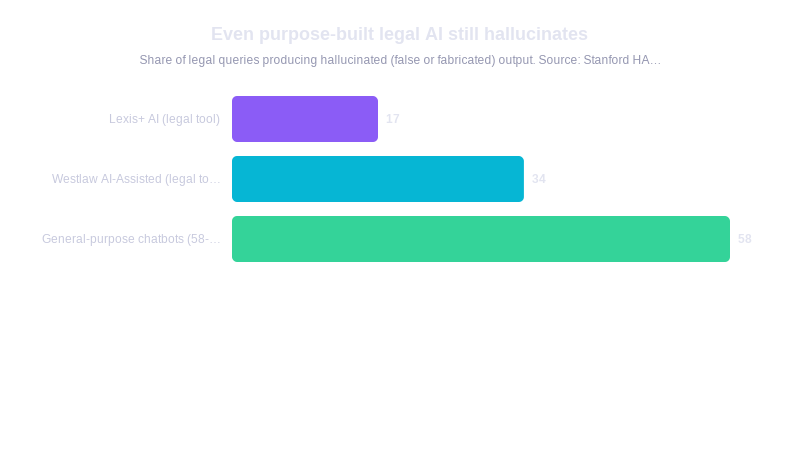
Confidentiality is not the only exposure. AI that fabricates citations creates its own liability, and even the legal-specific tools are not immune. A Stanford study, Hallucination-Free? Assessing the Reliability of Leading AI Legal Research Tools, found that purpose-built legal research tools still invent false information - Lexis+ AI hallucinated on more than 17% of queries and Westlaw's AI-Assisted Research on more than 34% (Stanford HAI, 2024). General-purpose chatbots did far worse on legal questions.
That is why every bar opinion in this space lands on the same duty: the lawyer, not the tool, is responsible for the output. As California's COPRAC puts it, "A lawyer's professional judgment cannot be delegated to AI and remains the lawyer's responsibility at all times" (State Bar of California, 2026).
A practical starting checklist
| Step | Why it matters |
|---|---|
| Read the tool's terms of use and privacy policy | Confirms whether your inputs train the model or reach third parties (ABA, 2024) |
| Use a business/enterprise tier with a data-protection agreement | Consumer tiers often reserve the right to use inputs; business tiers commonly do not |
| Get specific, informed client consent before entering confidential data | Boilerplate engagement language is not enough (ABA, 2024) |
| Never treat AI output as final | Leading legal AI still hallucinates 17%-34% of the time (Stanford HAI, 2024) |
| Check your own state bar's current guidance | Rules differ by state and are being updated |
What This Means for Your Business
If you run or advise a law firm, the message from the bar is not "avoid AI" - it is "use it deliberately." The efficiency gains are real, but the confidentiality duty is absolute and the tools are imperfect. The firms that win here will be the ones that pick vendors with genuine data protections, write a real AI policy instead of a boilerplate clause, and keep a human lawyer accountable for every output. If your firm handles sensitive matters, the same discipline applies to any regulated field - the parallels to protecting health data in our HIPAA-compliant marketing guide and to choosing trustworthy vendors in our best AI tools for small business guide are worth a read.
Semark LLC helps professional-services firms adopt AI without breaking client trust - from vendor vetting to a written AI-use policy that stands up to your state bar's rules. Learn more about our AI and machine learning services and our work with legal practices, or contact us to talk through your firm's setup.