
AI ROI Is an Efficiency Story, Not a Revenue Story (Yet)
Two-thirds of organizations already using AI report gains in productivity and efficiency, but only 20% say AI is currently growing their revenue, versus 74% who hope it will (Deloitte, State of AI in the Enterprise, 2026). If you are weighing an AI investment for your business, that gap is the single most important number to understand before you sign anything.
The honest version of the AI-ROI story is not the one in the vendor pitch deck. AI is paying off right now, but mostly by saving time and cutting cost, not by opening new revenue lines. Treating it as an efficiency tool is where the near-term return lives. Treating it as a growth engine is a bet on the future that most companies have not yet won.
What "AI ROI for business" actually looks like today
Deloitte surveyed 3,235 business and IT leaders across 24 countries between August and September 2025 for its 2026 State of AI in the Enterprise report. The results draw a clean line between what AI is delivering and what leaders wish it were delivering.
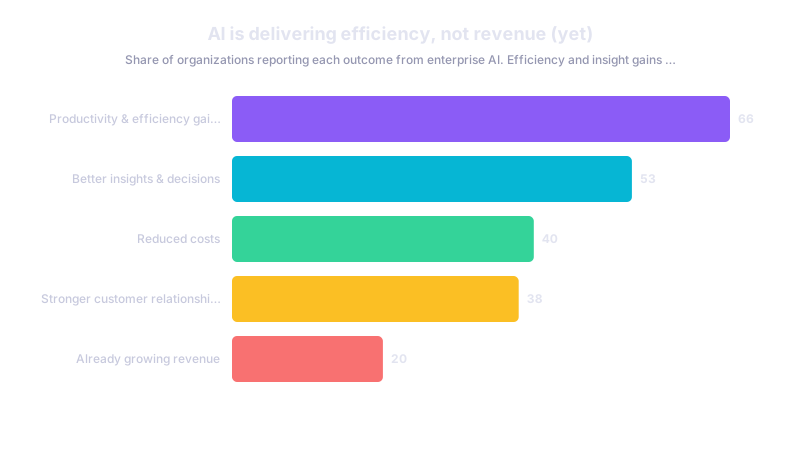
On the delivering side: 66% report gains in productivity and efficiency, 53% report better insights and decision-making, 40% report reduced costs, and 38% report stronger customer relationships (Deloitte, 2026). Those are efficiency and quality outcomes. They show up as hours saved, fewer errors, and faster turnaround.
On the wishing side: only 20% say AI is already growing revenue, while 74% are hoping to grow revenue through their AI initiatives in the future (Deloitte, 2026). That is a 54-point gap between aspiration and reality on the one metric business owners care about most.
Jim Rowan, US head of AI at Deloitte, framed the winners this way: "The organizations succeeding with AI aren't just investing in automation and algorithms, they're investing in their people" (Deloitte press release, 2026). Read that plainly. The return is coming from people doing existing work faster and better, not from AI inventing a new business model on its own.
Why efficiency pays first and revenue lags
There is a structural reason efficiency shows up before revenue, and it matters for how you plan.
Saving time is a closed-loop, controllable outcome. If a tool drafts your first-pass proposals, summarizes your customer emails, or handles routine intake questions, the time saved is measurable inside your own four walls. You do not need a customer to change behavior for the savings to be real.
Revenue growth requires the outside world to cooperate. A new customer has to find you, trust the AI-assisted experience, and buy more or more often. That depends on your market, your pricing, your competitors, and dozens of factors AI does not control. It is a longer, riskier chain, which is exactly why 74% are still hoping rather than reporting (Deloitte, 2026).
For a small or mid-market operator, the practical takeaway is to underwrite the AI purchase on efficiency alone. If the time or cost savings justify the spend, buy it. If the business case only works assuming new revenue that has not appeared for three-quarters of enterprises with far bigger budgets, treat that as upside, not as the plan.
Most businesses have not adopted AI at all yet
The efficiency-first reality gets sharper when you look at who is actually using AI. Despite the headlines, adoption among real businesses is still low. The US Census Bureau's Business Trends and Outlook Survey found overall AI usage hovering between 17% and 20% of firms from December 2025 through May 2026 (US Census Bureau, 2026).
Size is the dividing line. As of early May 2026, 37% of firms with 250 or more employees reported using AI, while firms with four or fewer employees stayed below 20% with no significant change over the period (US Census Bureau, 2026). The smallest businesses, the ones with the least slack to absorb a failed experiment, have moved the least.
This is good news for a patient operator. You are not behind a stampede. Most of your local competitors have not cracked this either, which means a modest, well-chosen efficiency win puts you ahead of the field rather than merely keeping pace. Our guide to simple AI automations for small business walks through the low-risk starting points.
Buy, do not build, and be skeptical of "agents"
Two more verified findings should shape how you spend.
First, buying beats building. In Menlo Ventures' 2025 State of Generative AI in the Enterprise report, based on a survey of 495 US enterprise AI decision-makers conducted November 7 to 25, 2025, 76% of AI use cases were purchased rather than built in-house, a reversal from the prior year's roughly even split (Menlo Ventures, 2025). That is enterprise data with enterprise engineering budgets. If large companies with dedicated AI teams are overwhelmingly choosing to buy off-the-shelf tools, a small business with no ML staff should treat custom development as a last resort, not a first move.
Second, be skeptical of the word "agent." The same Menlo Ventures report found that only 16% of enterprise AI deployments (and 27% at startups) qualify as true agents, meaning systems where the model actually plans, executes, observes the result, and adapts. Most products marketed as "agents" are basic if-then logic wrapped around a single model call (Menlo Ventures, 2025). If you are paying a premium for an "autonomous agent," confirm what you are actually getting. Our explainer on what AI agents are and how small businesses can use them covers the difference in plain language.
You will also hear that "95% of AI projects fail." That figure comes from a small, preliminary, non-peer-reviewed study and has been stretched well past what its authors claimed, so do not build fear or a business case around it. The more useful truth from the same body of research is mundane: general-purpose assistants like the mainstream chatbots move from pilot to everyday use fairly reliably, while custom, task-specific AI tools stall far more often. That is another vote for starting simple.
How to pick an AI investment that actually pays back
Here is a practical filter for evaluating any AI purchase as an operator, grounded in what the data says works.
| Test | Efficiency play (fund it) | Revenue play (treat as upside) |
|---|---|---|
| Where the return comes from | Hours and cost saved inside your business | New or larger sales from customers |
| How measurable it is now | Countable this quarter | Speculative, depends on the market |
| Who is proving it | 66% of surveyed firms (Deloitte, 2026) | Only 20% of surveyed firms (Deloitte, 2026) |
| Build or buy | Buy off-the-shelf | Buy off-the-shelf |
Buy the smallest tool that solves one real problem, measure the time it saves for 60 to 90 days, and only then expand. If revenue happens to follow, take it. But do not sign a contract whose math only works if you become the 20%, not the 66%.
What This Means for Your Business
The data is unusually consistent on one point: AI's proven return today is efficiency, and revenue growth is still mostly a hope, even inside large, well-funded companies. Two-thirds are saving time and cutting cost; only one in five is growing revenue (Deloitte, 2026). Adoption among small firms is still under 20% (US Census Bureau, 2026), and even the biggest players are buying rather than building (Menlo Ventures, 2025).
For a small or mid-market business, the winning move is to stop chasing the revenue story and claim the efficiency one. Pick a single, repetitive, time-eating task. Buy a proven tool, not a custom build. Measure the hours saved. That is a return you can bank this quarter, and it is a return most of your competitors have not yet bothered to collect.
If you want an honest, vendor-neutral read on where AI would actually save your team time, and where it would just cost you money, talk to us or explore our AI and machine learning services. We will help you underwrite the efficiency case before anyone promises you revenue.