
Most Small Businesses Have No Idea If Their Marketing Is Working
Here is a statistic that should scare you: 62% of small businesses cannot confidently say whether their digital marketing is profitable. They spend money on ads, SEO, social media, and content - and hope it is working because the phone is ringing. But they cannot tell you which channel is driving revenue and which is burning cash.
That is not a marketing problem. It is a measurement problem. And it is fixable.
This guide gives you the exact metrics, formulas, and tools to measure ROI across every digital marketing channel - no data science degree required.
The Only Formula You Need
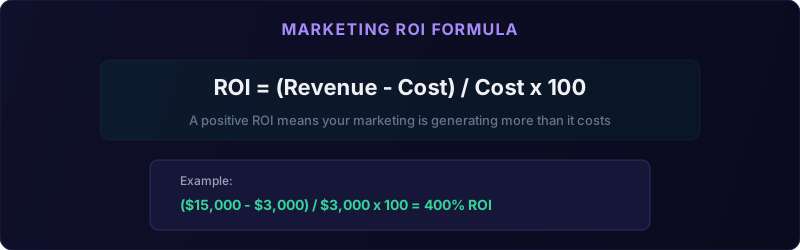
At its core, marketing ROI is simple:
ROI = (Revenue from Marketing - Cost of Marketing) / Cost of Marketing × 100
If you spend $3,000 on marketing and it generates $12,000 in revenue:
ROI = ($12,000 - $3,000) / $3,000 × 100 = 300%
That means for every dollar you spent, you got three dollars back. The challenge is not the formula - it is accurately tracking both sides of the equation.
If you are not sure where your marketing dollars should go in the first place, start with our digital marketing budget guide before setting up tracking.
Setting Up Tracking: The Foundation
Before measuring anything, you need three things in place:
1. Google Analytics 4 (GA4)
- Install it on every page of your website
- Set up conversion events for form submissions, phone calls, and purchases
- Enable UTM parameter tracking so you know which campaigns drive which results
2. Call Tracking
If your business generates phone leads, you need call tracking (CallRail, WhatConverts, or similar). Without it, a huge chunk of your conversions are invisible.3. CRM or Lead Tracking
Every lead should be tracked from first touch to closed deal. Even a spreadsheet works if you do not have a CRM. The point is knowing: this lead came from Google Ads → became a customer → spent $X.Measuring ROI by Channel
SEO ROI
SEO is the hardest channel to measure because results are delayed and organic traffic serves multiple purposes. Here is the practical approach:
What to track:
- Organic traffic (GA4 → Acquisition → Organic Search)
- Keyword rankings for your target terms
- Organic conversions (leads and sales from organic visitors)
- Organic revenue (if ecommerce) or lead value (if service business)
Example: You pay $2,000/month for SEO. Organic search generates 20 leads/month. Your close rate is 25%, and average deal value is $3,000. That is 5 clients × $3,000 = $15,000/month from SEO.
ROI = ($15,000 - $2,000) / $2,000 × 100 = 650%
For context on what good SEO work looks like, see our guide on what actually moves the needle in SEO.
Paid Ads ROI (Google Ads / Meta Ads)
Paid ads are the easiest to measure because every click is tracked.
What to track:
- Cost per click (CPC)
- Cost per lead (CPL) - total spend ÷ total leads
- Cost per acquisition (CPA) - total spend ÷ total customers
- Return on ad spend (ROAS) - revenue ÷ ad spend
| Metric | Good | Great |
|---|---|---|
| Google Ads CPC (service business) | $2-8 | Under $2 |
| Facebook/Instagram CPL | $10-30 | Under $10 |
| Overall ROAS | 3:1 | 5:1+ |
Social Media ROI
Social media ROI is notoriously hard to measure because much of its value is indirect (brand awareness, trust, community). Here is the practical approach:
Direct ROI (trackable):
- Traffic from social → website → conversion (track with UTM links)
- Direct messages that become leads
- Social ad conversions (same as paid ads)
- Brand search volume increases (people Googling your name after seeing your content)
- Engagement rate trends correlated with revenue trends
- Client acquisition surveys ("How did you hear about us?")
Email Marketing ROI
Email is the most measurable organic channel.
What to track:
- Open rate (benchmark: 20-25%)
- Click-through rate (benchmark: 2-5%)
- Revenue per email sent
- List growth rate
- Unsubscribe rate (should be under 0.5%)
Most email platforms (Mailchimp, ConvertKit) show revenue attribution natively if you set up ecommerce tracking.
Content Marketing ROI
Content marketing ROI compounds over time, making it tricky to measure month-to-month.
What to track:
- Organic traffic generated by each blog post
- Leads generated per post (use UTM links on CTAs)
- Content-assisted conversions (GA4 shows which pages users visited before converting)
- Cost per article vs. lifetime traffic value
The Metrics That Actually Matter (Ignore the Rest)
Here is a channel-by-channel ROI benchmark for small businesses:
| Channel | Typical ROI | Time to Measure | Tracking Difficulty |
|---|---|---|---|
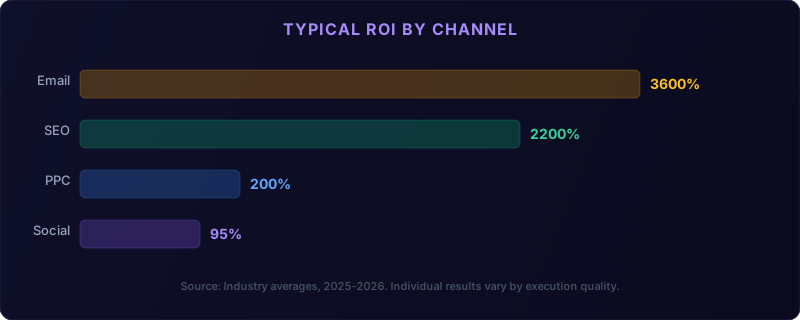
| Google Ads | 200-400% | 1-2 months | Easy |
| SEO | 300-800% | 6-12 months | Medium |
| Email Marketing | 3,600% (avg) | 1-3 months | Easy |
| Social Media (organic) | Hard to isolate | 3-6 months | Hard |
| Social Media (paid) | 150-300% | 1-2 months | Easy |
| Content Marketing | 300-600% | 6-18 months | Medium |
Stop tracking these vanity metrics:
- ❌ Total website visitors (without conversion context)
- ❌ Social media followers
- ❌ Email list size (without engagement)
- ❌ Impressions
- ❌ "Brand awareness" without any measurement framework
- ✅ Cost per lead (CPL) - What you pay to get someone into your pipeline
- ✅ Cost per acquisition (CPA) - What you pay to get a customer
- ✅ Customer lifetime value (CLV) - Total revenue per customer
- ✅ Marketing-sourced revenue - Revenue directly tied to marketing efforts
- ✅ Payback period - How long until marketing spend is recovered
Building a Simple ROI Dashboard
Here is what your monthly dashboard should look like:
| Metric | Google Ads | SEO | Social | Total | |
|---|---|---|---|---|---|
| Spend | $2,000 | $1,500 | $800 | $100 | $4,400 |
| Leads | 25 | 15 | 5 | 10 | 55 |
| Cost/Lead | $80 | $100 | $160 | $10 | $80 |
| Customers | 6 | 4 | 1 | 3 | 14 |
| Revenue | $18,000 | $12,000 | $3,000 | $9,000 | $42,000 |
| ROI | 800% | 700% | 275% | 8,900% | 855% |
You do not need expensive tools. Here is a free setup that works:
- Google Analytics 4 - Website traffic and conversion tracking
- Google Looker Studio - Free dashboards pulling from GA4, Google Ads, and Search Console
- Google Sheets - Manual CRM tracking for lead-to-customer conversion
- UTM Builder - Tag every link so you know exactly where traffic comes from
- Monthly spend by channel
- Leads by channel
- Cost per lead by channel
- Revenue by channel (even estimated)
- Overall marketing ROI
Want us to set up proper ROI tracking for your business? Schedule a free analytics consultation and we will audit your current setup and show you exactly what is missing.
Attribution: The Hard Part
The reality is that a customer rarely converts from a single touchpoint. They might:
- Find you through a Google search (SEO)
- Follow you on LinkedIn (social)
- Read three blog posts over two weeks (content)
- Click a retargeting ad (paid)
- Fill out a contact form (conversion)
- First-touch attribution - Credit goes to the channel that first brought them to your site. Best for understanding what creates awareness.
- Last-touch attribution - Credit goes to the last interaction before conversion. Best for understanding what closes deals.
- Data-driven attribution - GA4's model distributes credit across touchpoints. Best overall, but requires enough data.
How to Know If Your Marketing Budget Is Right
Once you are tracking ROI, you can answer the golden question: should I spend more or less?
Increase budget when:
- ROI is above 3:1 consistently
- You are turning away leads or have capacity to serve more clients
- Cost per lead is stable or decreasing as you scale
- ROI drops below 2:1 for three consecutive months
- Cost per lead is rising without quality improvement
- A channel is generating traffic but not leads or revenue
For the complete picture of where to invest and what to expect, read our complete digital marketing guide. And if paid ads are part of your mix, our Google Ads vs SEO breakdown helps you allocate effectively.
Start Measuring Today
You do not need perfect data to start. Even rough ROI tracking is infinitely better than none. Here is your action plan:
- This week: Install GA4 and set up conversion tracking for your top form or phone number
- This month: Tag all marketing links with UTM parameters
- Next month: Build a simple monthly dashboard in Google Sheets or Looker Studio
- Ongoing: Review monthly and adjust spend based on what the data tells you
Need help setting up proper tracking for your marketing? Explore our digital marketing services - measurement and accountability are built into everything we do.
Frequently Asked Questions
What is a good marketing ROI? A 3:1 return (three dollars earned per dollar spent) is good. 5:1 or higher is excellent.
How do I track marketing ROI for free? Google Analytics 4, Google Search Console, and a simple spreadsheet to track leads to customers.
What is cost per lead? Total marketing spend divided by total leads generated. A key metric for measuring channel effectiveness.
Why is my marketing ROI hard to measure? Most customers interact with multiple channels before converting, making single-channel attribution difficult.
How often should I review marketing ROI? Monthly for active campaigns. Quarterly for overall strategy assessment and budget reallocation decisions.