
Most app launch plans assume installs come from search. Someone types "learn AI," your app comes up, they install it. So the whole plan becomes keywords.
Our own Play Console data says otherwise. We built and launched an Android app - AI For Everyone, an AI-learning app for absolute beginners - and watched every install channel for nine months. Search was not the main driver. It was not even close, and for the first four months it contributed nothing at all.
Short answer: Google Play reports installs by channel, and the biggest one for a new app is usually Explore - Play's algorithmic recommendation surface, which you cannot buy your way onto. Search takes months to contribute anything, then grows steadily. If your launch plan is keywords-only, you have optimized for the channel that shows up last.
The three channels Play actually reports
Play Console splits store listing acquisitions into a few sources. The three that matter for most publishers:
| Channel | What it means | What drives it |
|---|---|---|
| Google Play explore | Someone found you while browsing - category pages, "similar apps," recommendations, editorial surfaces | Engagement quality, retention, ratings, install-to-uninstall ratio |
| Google Play search | Someone typed a query and picked you | Keyword relevance in your listing, install volume, engagement on those keywords |
| Ads and referrals | Paid campaigns plus links from outside Play - your site, social, press | Ad spend and off-Play marketing |
The important structural fact: Explore is earned, Search is earned more slowly, and only the third one can be bought. For a publisher with no ad budget, the entire strategy lives in the first two.
What nine months of data looked like
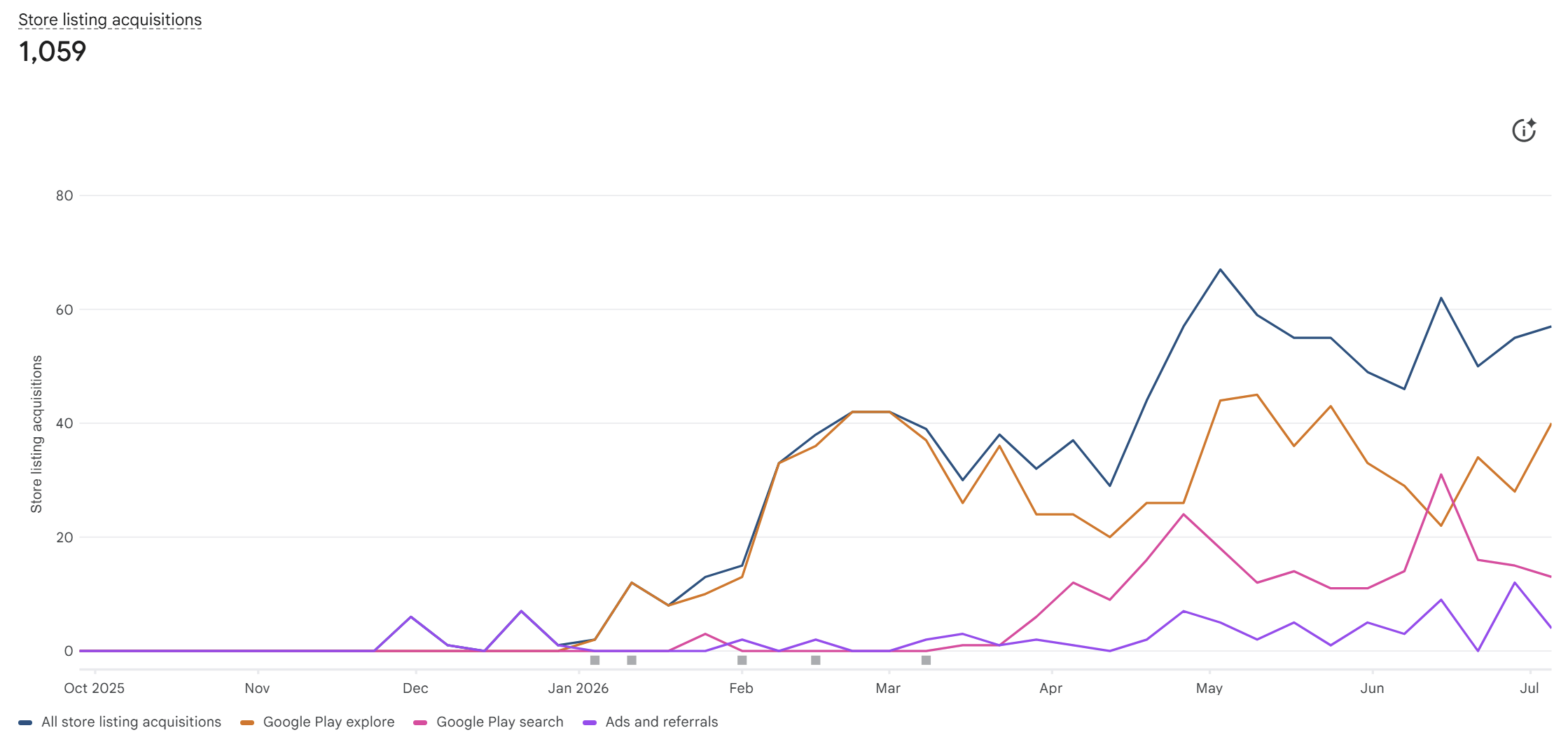
Reading that chart channel by channel:
- October-November 2025: flat zero. The app was live and effectively invisible. This is the cold-start period every new listing goes through.
- December-January: the first movement, almost entirely Explore. Play started sampling the app into browse surfaces.
- February: the first real ramp - Explore jumps and takes the total with it.
- March onward: Play search finally becomes a real channel, climbing from zero to a steady weekly contributor.
- May onward: a second, larger ramp, with Explore and Search both feeding it. Peak week hit 67 installs.
The shape matters more than the totals. Explore led throughout. Search contributed nothing for roughly four months and then compounded - which is exactly the curve organic search produces on the web, just with a longer fuse.
Why Explore comes first
Play's browse and recommendation surfaces are the store deciding, on your behalf, that users like your app. The inputs are behavioural: do people keep it, open it again, rate it, finish what they started.
That has a consequence most launch plans miss. On Google Play, retention is not a post-launch metric - it is the acquisition strategy. An app that holds attention gets shown to more people, which produces more installs, which produces more signal. An app that leaks users never enters the loop, no matter how good its keywords are.
This is why we built AI For Everyone around a five-phase lesson loop (Story, Learn, Play, Challenge, Reward) with XP, daily streaks, and a badge vault before we wrote a single line of the store listing. The gamification was not a nice-to-have on top of the content. It was the distribution plan.
Why Search takes months
A new listing has no install history on any keyword, so Play has nothing to rank it on. Relevance alone is not enough - the store needs evidence that people who search a term and see your app actually install and keep it.
That evidence only accumulates once other channels are already delivering users. Which means the honest sequencing is:
- Explore installs happen first (driven by engagement)
- Those installs generate keyword-level signal
- Search rankings mature
- Search becomes a compounding channel of its own
The lever you control immediately: listing conversion rate
Channels decide how many people see your listing. Your listing decides how many of them install. That second number is fully in your control from day one, and it multiplies everything else.
At 20.13%, roughly one in five people who reached the listing installed the app. Every point of conversion rate is a permanent multiplier on every future impression from every channel - and unlike rankings, it responds to changes in days rather than months.
Practical things that move it:
- Screenshots that show the mechanics, not the feature list. We led with actual game screens - a neural network builder, a model-configuration challenge, the badge vault. Not marketing slabs of text.
- A short description that answers "what is this and can I do it?" in one line. Our audience needed to know it started from zero.
- A long description mapped to real phrases people search - "how ChatGPT works," "machine learning for beginners," "learn AI free" - written for humans and covering the vocabulary.
- Honest content ratings and a complete Data safety section. Incomplete listings suppress themselves.
What to do with this
If you are planning an app launch:
- Budget the first quarter for engagement, not keywords. The store rewards retention, and everything else follows from it.
- Ship the retention mechanics in v1. Streaks, progress, and rewards are not polish you add later - they are what earns you distribution.
- Instrument channel-level attribution from day one. If you cannot tell Explore from Search, you cannot tell whether your ASO is working or your product is.
- Treat listing conversion as the fastest lever you own. It compounds against every channel simultaneously.
- Do not judge the launch before month four. The quiet period is structural, not a verdict.
- You do not need a UA budget to start. We proved that here with $0 of it. What you need is a product worth reopening and a listing worth converting.
The data in this post comes from Google Play Console for AI For Everyone, an Android app we built and launched for AIPowered. The full build and results are in the case study.