
One in five organizations that suffered a data breach in 2025 traced it to "shadow AI" - unauthorized AI tools employees use without approval - and those breaches cost about $670,000 more than average (IBM Cost of a Data Breach Report 2025). The uncomfortable part for most owners: you do not have to buy a single AI product for this risk to already exist inside your business. Your bookkeeper, your sales rep, and your office manager can create it on their own, for free, in a browser tab you will never see.
Short answer: Shadow AI is the use of AI chatbots and tools that your business never approved or configured. It is already common - roughly 77% of employees who use generative AI paste data directly into the prompt, and 82% of that pasting happens through personal, unmanaged accounts (LayerX Enterprise AI & SaaS Data Security Report 2025). The danger is not the AI being "smart." It is that customer records, contracts, and source code get copied into a third party's system with no logging, no contract, and no way to get the data back.
What "shadow AI" actually means
Shadow AI is the AI version of an old problem. For years, IT teams worried about "shadow IT" - employees signing up for unapproved apps to get their work done faster. Shadow AI is the same instinct pointed at chatbots: an employee opens a free AI tool on a personal login and pastes in whatever they are working on to summarize it, rewrite it, debug it, or answer a question.
It feels harmless because it is so ordinary. Nobody thinks of "pasting a paragraph into a chat box" as exporting company data. But that is exactly what it is. Once text leaves your environment and lands in a consumer AI account, you have no contract governing how it is stored, no audit trail, and - depending on the tool's settings - no guarantee it will not be retained or used to train future models.
The most cited real-world example is still one of the clearest. In 2023, Samsung engineers pasted proprietary semiconductor source code and the transcript of an internal meeting into ChatGPT to get help with a bug and to generate notes. Within about 20 days of allowing the tool, the company logged three separate leaks of sensitive information and banned external chatbots on company devices (Forbes, 2023). No hacker was involved. Skilled employees simply used a helpful tool the way it was designed to be used.
How common is this, really?
Common enough that it is safer to assume it is already happening than to assume it is not. Browser-telemetry research from enterprise environments found that about 45% of employees use generative AI tools, 77% of those users paste data straight into the prompt, and 82% of that pasting flows through personal accounts that sit entirely outside company oversight (LayerX Enterprise AI & SaaS Data Security Report 2025). That last number is the one that should get an operator's attention: the activity is not just happening, it is happening on logins your business cannot see, control, or shut off.
There is a revealing gap here. Official AI adoption is still modest. Roughly 17% to 20% of US firms report using AI in their operations, and the rate is under 20% for the smallest firms while reaching 37% for firms with 250 or more employees (US Census Bureau, Business Trends and Outlook Survey, 2026). In other words, a company can honestly report "we don't use AI" while a large share of its staff quietly do. The org chart says one thing; the browser history says another. Shadow AI lives precisely in that gap.
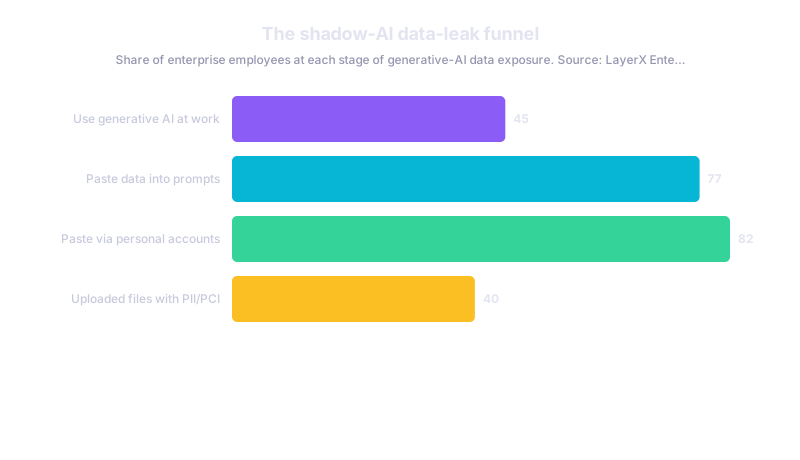
A quick note on that research: it comes from large enterprise environments, not small businesses, so treat the exact percentages as enterprise figures rather than a precise reading of your five-person office. But the mechanism does not care how big you are. If anything, a small business is more exposed, because it is far less likely to have the security tooling that surfaces this behavior at all.
What actually leaks
The risk is not abstract "data." It is the specific, regulated, hard-to-replace information your business runs on. In the same enterprise research, 40% of files uploaded into generative AI tools contained personally identifiable information (PII) or payment card data (LayerX, 2025). And when shadow AI was involved in an actual breach, the fallout skewed toward exactly the wrong assets: personal information was compromised in 65% of shadow-AI incidents versus a 53% global average, and intellectual property in 40% versus a 33% average (IBM Cost of a Data Breach Report 2025).
Translate that to a normal week at a normal company. A staffer pastes a spreadsheet of customer names and card numbers into a chatbot to "clean it up." A paralegal drops a client contract in to get a plain-English summary. A clinic employee pastes a patient message to draft a reply. A developer shares a chunk of your proprietary code to fix an error. Each is a small, well-intentioned shortcut. Each can also be a reportable data incident - and in regulated fields like healthcare, legal, and finance, the compliance exposure can dwarf the convenience gained. If your business handles protected health information, the same care you would apply to email (see our guide on HIPAA-compliant email marketing for healthcare) applies double to AI chat boxes.
Why it costs so much when it goes wrong
The reason shadow AI shows up as a $670,000 premium on breach costs is not that AI is uniquely dangerous - it is that shadow AI is, by definition, ungoverned. You cannot secure what you cannot see. IBM's researchers found that 63% of breached organizations either had no AI governance policy or were still building one, and among organizations that suffered a breach involving AI models or applications, 97% lacked proper AI access controls (IBM Cost of a Data Breach Report 2025).
As IBM's Suja Viswesan, Vice President of Security and Runtime Products, put it: "The data shows that a gap between AI adoption and oversight already exists, and threat actors are starting to exploit it. The report revealed a lack of basic access controls for AI systems, leaving highly sensitive data exposed, and models vulnerable to manipulation."
That is the whole problem in two sentences. Adoption is running ahead of oversight. The tools arrived faster than the policies, and employees - trying to do good work - filled the gap themselves.
Why banning it usually backfires
The instinct after reading all this is to send a company-wide email banning AI tools. It rarely works, and it can make things worse. A blanket ban does not remove the incentive that created shadow AI in the first place - people still have too much to do and a tool that helps them do it. It just pushes the usage further underground, onto personal phones and home laptops where you have even less visibility.
The more durable answer is to give people a sanctioned path that is easier than the shadow one. In practice that means a short, specific policy paired with an approved tool:
| Instead of | Do this |
|---|---|
| A vague "don't use AI" email | A one-page policy naming which tools are approved and what data is never allowed in them |
| Personal free accounts | A business-tier account where data is not used for training and usage can be administered |
| Assuming staff know the rules | A 20-minute session with concrete examples: no customer PII, no contracts, no source code, no patient data |
| No visibility | A designated owner who fields "can I use AI for this?" questions so people ask instead of guessing |
What This Means for Your Business
Assume shadow AI is already present. With 77% of generative-AI users pasting data into prompts and 82% of that happening on unmanaged personal accounts (LayerX, 2025), the realistic question is not whether someone on your team has pasted company information into a chatbot - it is what, and how often. You will not find out by asking once in a meeting; you find out by making it safe to admit and easy to do the right thing.
Three concrete moves this week: write one page defining approved tools and off-limits data (customer PII, payment details, contracts, credentials, patient records, proprietary code); move any real AI use onto business-tier accounts where your inputs are not used to train models and access can be managed; and hold a short, example-driven training so the rules are memorable rather than theoretical. None of this requires a big budget. It requires deciding to own the risk before it owns you.
If you would rather build AI into your operations deliberately - with the data handling, tooling, and guardrails thought through from the start instead of stitched together after a scare - that is exactly the kind of work we do. Explore our AI and machine learning services, or contact us to talk through a shadow-AI policy and a safe, approved setup for your team.