
Investors are betting that AI mentions are becoming the new rankings: Profound raised $96 million at a $1 billion valuation in February 2026 to help brands measure and manage how AI describes them (Fortune, 2026). But you do not need a funded platform to find out where you stand today.
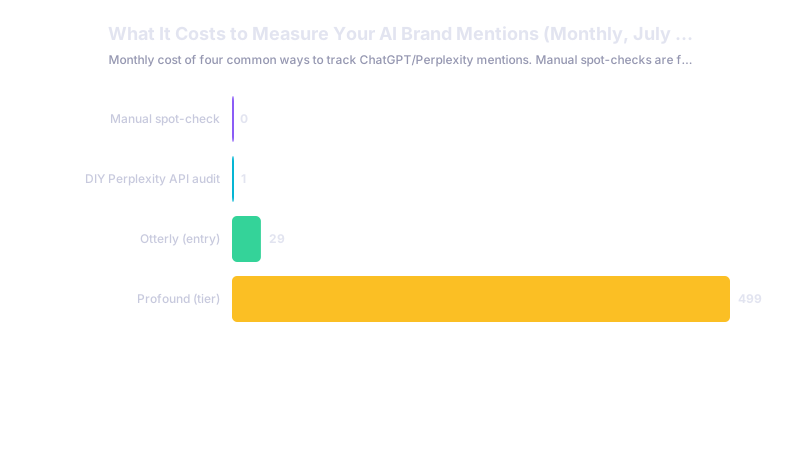
Short answer: There are three ways to tell whether ChatGPT and Perplexity recommend your business. (1) Manual spot-checks - run the same 10-20 real buyer prompts through each engine once a month in a fresh, logged-out session and log whether you're mentioned, cited, or actively recommended (free, about an hour). (2) A paid AI-visibility tool that automates prompt testing and share-of-voice reporting ($29/mo for Otterly up to $399-$499+/mo for Profound, per Justin McKelvey, 2026). (3) A DIY checker on the Perplexity Sonar API, which returns citations with every answer for roughly a penny per query. Perplexity is the most measurable surface because it shows inline citations on every response.
First, define what "recommend" means: three levels to track
Before you measure anything, separate three outcomes that people lump together, because they are very different wins:
- Mention - the AI names your business somewhere in an answer.
- Citation - the AI links your page as a source. Perplexity shows these inline on every answer.
- Recommendation - the AI actively suggests you to a buyer, e.g. "the best plumber in Austin is…"
Method 1: Free manual spot-checks (about an hour a month)
Write 10-20 prompts a real buyer would actually type - "best HVAC company near me," "top-rated med spa in Dallas," "affordable bookkeeper for a small restaurant." Run each one through ChatGPT, Perplexity, Gemini, and Google AI Overviews in a clean, logged-out session with no chat history, so your own past searches don't skew the result. For every prompt, log mention / citation / recommendation for you and two or three competitors.
Monthly is the right cadence. Answers shift as models and search indexes update, but not fast enough to reward weekly checking. Free, repeatable, and over a few months the log becomes your trend line - which is the whole point.
Method 2: Paid AI-visibility tools ($29-$499+/mo)
Tools like Otterly, Peec AI, and Profound automate prompt testing, track mention frequency, and report share of voice across the major engines. Otterly, for example, tracks ChatGPT, Perplexity, Google AI Overviews, AI Mode, Gemini, Copilot, and Claude, reporting mention counts, average position, and share of voice; one sample dashboard shows 3,181 brand mentions out of 410,785 tracked citations at an average position of 2.05 (Otterly.ai, 2026).
Pricing runs from about $29/month for Otterly's entry tier to roughly $399-$499+/month for Profound's tiers, with enterprise plans reaching thousands (Justin McKelvey, 2026). The enterprise interest is real: Profound raised a $96M Series C at a $1B valuation in February 2026, led by Lightspeed Venture Partners, bringing total funding past $155M, and reports 700+ enterprise customers and roughly 10% of the Fortune 500 (Fortune, 2026). These tools add competitive benchmarking and sentiment you can't easily assemble by hand - but they're overkill for a single-location small business. Buy one once you're tracking dozens of prompts and competitors, not before.
Method 3: Build your own checker on the Perplexity API
If you're technically comfortable, you can skip the subscription entirely. As Justin McKelvey, a fractional CTO who has shipped 50+ products, puts it: "The Perplexity Sonar API is the workhorse because it does live web-grounded search and returns citations with every answer." A single brand-check query costs about a penny, and a full 20-prompt monthly audit runs well under $1 (Justin McKelvey, 2026).
The build is simple: loop your prompt list, send each to the API, parse the response for your domain and brand name, and log mention / citation / recommendation to a spreadsheet. You get the same raw citation data the paid tools charge to visualize - you're just skipping the dashboard.
The metrics that actually matter
Once you're logging results, track four things and ignore the rest:
- Share of voice - how often you appear versus competitors across your tracked prompts.
- Citation frequency - how often your pages are the linked source, not just named.
- Sentiment - how the AI frames you when it does mention you.
- Recommendation rate - the share of buyer prompts where you're actively suggested.
Why Perplexity is your most measurable surface
Perplexity ships visible citations on every answer, so you see not just whether you appear but which page earned it and who beat you. ChatGPT and Gemini cite less consistently, which makes them harder to audit by hand. Use Perplexity as your primary measurement engine, then sanity-check ChatGPT and Google AI Overviews.
Focus your tracking on where you're talked about, not just linked. Ahrefs' study of 75,000 brands found off-site brand web mentions correlate with AI Overview visibility far more strongly than backlinks - 0.664 versus 0.218 - and the most-mentioned quartile of brands averaged about 169 AI Overview mentions versus roughly 14 for the next quartile, about 10x more (Ahrefs, May 2025). What you measure in Perplexity today usually predicts where the other engines are heading.
This matters because clicks are drying up. AI Overviews now reduce the click-through rate on the #1 organic result by about 58% (Ahrefs, Feb 2026), and Pew Research found users click a traditional result only 8% of the time when an AI summary is present, versus 15% without (Pew Research Center, Jul 2025). If fewer people click, being the answer - and measuring whether you are - matters more than tracking traffic.
What This Means for Your Business
Start free: 15 buyer prompts, four engines, one hour, once a month. You'll know your baseline by next week. Track mention, citation, and recommendation separately so you know which gap to close. Only pay for a tool once manual tracking gets unwieldy - many prompts, many competitors.
Measurement is the missing half of generative engine optimization. Most businesses optimize to get recommended by ChatGPT without ever checking if it worked - like running ads with the conversion tracking turned off. If you want to get cited in Perplexity and understand how ChatGPT chooses which businesses to recommend, start by measuring where you stand.
Want to know exactly where you stand in ChatGPT and Perplexity - and close the gaps? Semark sets up your AI-visibility tracking and the GEO work to move it. Get a free AI-mention audit at /contact or see our generative engine optimization service.