
In the first four months of 2026, 68.01% of US Google searches ended without a click - up from 60.45% in 2024 (SparkToro, 2026). If most searches never send a visitor anywhere, the obvious question for any business owner budgeting for the year is: do you keep paying for SEO, pivot to Generative Engine Optimization (GEO), or somehow fund both?
Short answer: For most local and small businesses in 2026, GEO vs SEO is a false choice. The same signals - brand mentions, cited sources, quotations, real statistics, and genuinely human, expertise-driven content - feed both Google rankings and AI answers. Put the bulk of your budget into the SEO and content foundation that also powers AI Overviews and ChatGPT citations, then layer GEO tactics on top rather than funding a separate GEO line item. A pure-GEO play only makes sense once you have proof that AI search sends your specific vertical qualified leads.
GEO vs SEO: What's Actually Different (and What Isn't)
SEO - search engine optimization - is the discipline of ranking in the classic list of blue links. GEO - generative engine optimization - is about getting your business cited, quoted, and recommended inside AI-generated answers: Google's AI Overviews, ChatGPT, Perplexity, and the like. Different surfaces, same underlying goal: be the source a searcher trusts.
The temptation in 2026 is to treat these as two separate budgets with two separate agencies. That framing sells packages, but it misreads how the systems actually work. As international SEO consultant Aleyda Solis puts it:
"There's definitely an overlap between the optimization pillars between LLMs and traditional search engines, although there are also important differences that need to be taken into account when establishing an strategy for each, such as the level of personalization or the need to optimize for the context -rather than queries- with LLMs due to the query fan-out technique." - Aleyda Solis, Founder, Orainti
That is the honest version of the story. There are real differences - AI answers personalize more and optimize around context rather than a single typed query. But the pillars overlap heavily. GEO is not a replacement for SEO. It is the same authority signals being evaluated by a new consumer: the model. So this is a budget-allocation decision, not an either/or switch.
Is AI Search Big Enough to Invest In Yet?
The case for taking AI search seriously is not hype - it is measurable erosion of the click.
- Zero-click is the new normal. 68.01% of US Google searches ended without a click in early 2026, versus 60.45% in 2024 (SparkToro, 2026).
- AI Overviews suppress clicks on even your best ranking. The presence of an AI Overview now correlates with a 58% lower average click-through rate for the top-ranking page (Ahrefs, February 2026, using December 2025 data).
- Independent data agrees. When an AI summary appears, users click a traditional search result just 8% of the time, versus 15% when no summary is shown (Pew Research Center, 2025). Google disputes Pew's methodology, so treat the exact split as directional - but the direction is not in doubt.
"Don't take that the wrong way - your SEO still matters as much or more than ever before, it just won't earn you traffic the way it once did." - Rand Fishkin, Founder, SparkToro
In other words: the work that earns rankings still matters, but you now have to measure influence and citations, not only clicks. That reframing - instrument for being mentioned, not just visited - is the actual 2026 shift.
What Still Works Is the Same Foundation
Here is the part that collapses the GEO-vs-SEO dichotomy: the signals that get you into AI answers are the signals that already defined strong SEO.
Ahrefs studied 75,000 brands and found that brand web mentions correlate with AI Overview visibility far more strongly (0.664) than backlinks do (0.218) (Ahrefs, May 2025). The gap between the well-known and the unknown is stark - brands in the top quartile for web mentions averaged 169 AI Overview mentions, more than 10x the roughly 14 averaged by the next quartile down. Being a recognized name in your market is the single biggest lever for showing up in AI answers, and that is exactly what good SEO and PR have always built.
The other fear - that AI-generated content farms will bury real businesses - also doesn't hold up. Analyzing roughly 31,000 search queries, Graphite found that 86% of articles ranking in Google Search and 82% of articles cited by ChatGPT and Perplexity are written by humans (Graphite, 2025). Mass-produced AI content is not winning the cited results. Real human expertise is.
The takeaway writes itself: the SEO fundamentals - brand mentions, authority, and genuine human expertise - are the GEO fundamentals. You are not choosing between two foundations. There is one.
Where GEO Tactics Actually Move the Needle
So if the foundation is shared, what is genuinely "GEO"? A small set of on-page tactics that make your content easier for a model to extract and cite.
The most-cited evidence is the academic paper that coined the term - "GEO: Generative Engine Optimization" (Aggarwal et al., ACM KDD 2024). Testing tactics against generative engines, the researchers found that adding relevant quotations, statistics, and source citations to content produced the biggest visibility gains, boosting AI-engine visibility by up to 40%. Their lead author summarized it:
"Our top-performing methods - Cite Sources, Quotation Addition, and Statistics Addition - achieved a relative improvement of 30-40% on the Position-Adjusted Word Count metric... the efficacy of these strategies varies across domains, underscoring the need for domain-specific optimization methods." - Pranjal Aggarwal, lead author, "GEO: Generative Engine Optimization" (ACM KDD 2024)
The specific numbers, on the paper's Position-Adjusted Word Count metric:
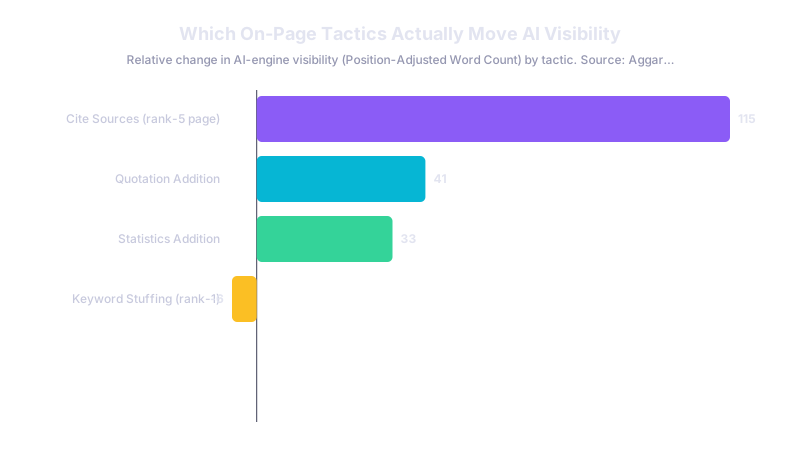
- Quotation Addition was the single strongest method: +41% (a score of 27.8 against a 19.5 baseline).
- Statistics Addition delivered +33%.
- Cite Sources was ranking-dependent - it lifted a fifth-ranked page's visibility by 115.1% in one case, while the average top-ranked page actually lost ground.
- Keyword Stuffing backfired - it performed below the no-optimization baseline, confirming that the old spam tactic actively hurts in generative engines.
The 2026 Budget Math: What SEO and GEO Actually Cost
Pricing is where a lot of "GEO packages" get sold on fear. Here are illustrative benchmark ranges - treat them as ballpark orientation, not hard cited figures, since agency pricing varies widely and is rarely published to a single authoritative source.
| Approach | Typical monthly range (illustrative) |
|---|---|
| Local / single-location SEO | ~$500-$2,000 |
| Small-business SEO | ~$1,500-$5,000 |
| Competitive / multi-location | ~$5,000-$15,000 |
| Enterprise | ~$15,000+ |
Here is the part worth internalizing: most "GEO services" being sold in 2026 are SEO and content work plus schema markup, citation building, and an llms.txt file. Valuable, but rarely a justified separate budget line for a small business. You are paying twice for one foundation.
And be skeptical of headline ROI numbers on both sides. First Page Sage, for example, reports that thought-leadership SEO delivered a 748% average return and a 9.10 ROAS with a roughly nine-month break-even (First Page Sage, 2025) - but that is the agency's own self-reported proprietary data from its client campaigns, not independently audited research. Useful as a directional signal that content-led SEO can pay back; not a number to underwrite your forecast.
Our Verdict: Where to Invest by Business Type
There is no single answer, but there is a clear pattern by business type.
Local and service businesses (plumbers, clinics, contractors, salons). Put roughly 80% of your budget into the SEO foundation: an optimized website, a well-managed Google Business Profile, and a steady flow of genuine reviews. That same foundation is what feeds AI answers about local providers. Layer GEO tactics - clear, extractable content and structured data - on top. Do not fund a standalone GEO agency here.
Content-led and considered-purchase brands (SaaS, legal, healthcare, B2B). These verticals justify heavier GEO investment. When buyers research for weeks and clicks are shrinking, being the source that gets cited and quoted inside an AI answer is the win - even without the click. Invest in authoritative, expert-authored, citation-rich content and measure your share of AI mentions deliberately.
Everyone. Build brand mentions and human, cited, statistic-rich content first. Add structured data and llms.txt second. And do not sign a separate GEO retainer until you have confirmed that AI search actually sends your vertical qualified leads - not just impressions.
For a deeper build-out of either side, see our guides on how small businesses get found by AI search (GEO), SEO in 2026: what actually moves the needle, and how to optimize for Google AI Overviews.
What This Means for Your Business
Stop framing 2026 as GEO vs SEO. Fund the one shared authority foundation - brand mentions, human expertise, cited sources, current statistics - and instrument your measurement for citations, not just clicks. Concretely:
- Audit your best pages. Do they cite sources, quote named experts, and include current statistics? Those are the exact upgrades the GEO research rewards, and they are cheap to add.
- Measure AI visibility alongside rankings and leads. Track how often you are mentioned or cited in ChatGPT, Perplexity, and AI Overviews. In a 68%-zero-click world (SparkToro, 2026), a citation you never got a click from is still working for you.
- Don't buy a second budget for one job. If a "GEO package" is mostly schema, citations, and an
llms.txtfile bolted onto content you should already own, it is SEO with a new label.