
Fewer than 20% of the smallest U.S. firms (four or fewer employees) actually use AI, and adoption barely moved for small businesses between December 2025 and May 2026 (U.S. Census Bureau, 2026). Yet your inbox is full of consultants and agencies insisting you are already behind. That gap between the sales pitch and the ground truth is exactly where bad deals hide.
Short answer: The biggest AI consultant red flags are: leaning on the scary "95% of AI projects fail" headline to pressure you, promising revenue growth instead of efficiency, pitching autonomous "AI agents" or a custom-built model before they understand your workflow, quoting big-enterprise benchmarks at your small business, and refusing to give you ownership of your accounts, data, and prompts. A good partner scopes a narrow, measurable problem and lets you keep the keys.
Red flag 1: They weaponize the "95% of AI fails" scare stat
You will hear some version of "95% of AI projects fail, so you need us to be in the 5%." That number traces to a single preliminary report, MIT NANDA's State of AI in Business 2025, built on just 52 interviews and 153 survey responses, which its own authors describe as "directionally accurate" rather than official measurement. The precise finding is far narrower than the headline: among custom, task-specific GenAI tools, roughly 60% were evaluated, 20% piloted, and only about 5% reached production, while general-purpose tools like ChatGPT and Copilot reached implementation around 83% of the time (MIT NANDA, 2025). A consultant who cites the folklore version without the nuance either has not read the source or is counting on you not to. Both are bad signs.
Red flag 2: They promise revenue growth, not efficiency
Honest AI wins are usually about doing existing work faster and cheaper, not conjuring new sales. In Deloitte's survey of 3,235 leaders, 66% reported efficiency and productivity gains from AI, but only 20% were already growing revenue from it, versus 74% who merely hoped to (Deloitte, 2026). If a consultant's pitch centers on "AI will grow your revenue by X%," treat that as a forecast they cannot back up. Ask instead which specific task will get cheaper, by how many hours, and how you will measure it. Our guide on when to automate versus when to hire walks through that math.
Red flag 3: Everything is an "AI agent"
"Agentic AI" is the buzzword of the moment, and it is mostly marketing. In Menlo Ventures' survey of nearly 500 enterprises, only 16% of enterprise AI deployments qualified as true agents that plan, act, and adapt; the rest were "fixed-sequence or routing-based workflows wrapped around a single model call" (Menlo Ventures, 2025). There is nothing wrong with a simple workflow, and for most small businesses that is exactly the right tool. But a consultant charging agent prices for what is really a chatbot with a script is overselling. If you want to understand the real distinction, see what AI agents actually are and how small businesses can use them.
Red flag 4: They want to build a custom model before understanding your work
Building a bespoke model or fine-tuning your own is expensive, slow, and rarely necessary. The market has voted the other way: in 2025, 76% of enterprise AI use cases were purchased rather than built in-house, up from 53% a year earlier (Menlo Ventures, 2025). If deep-pocketed enterprises are buying off-the-shelf, a consultant steering your small business toward a from-scratch custom build is usually protecting their billable hours, not your budget. The deeper tell is why generic tools sometimes stall. As Aditya Challapally, lead author of the MIT NANDA report, put it: "Generic tools like ChatGPT excel for individuals because of their flexibility, but they stall in enterprise use since they don't learn from or adapt to workflows" (Fortune, 2025). The fix for that is thoughtful integration into your process, not an expensive new model. A partner who has not asked detailed questions about your actual workflow cannot possibly know which approach you need.
Red flag 5: They quote enterprise benchmarks at your small business
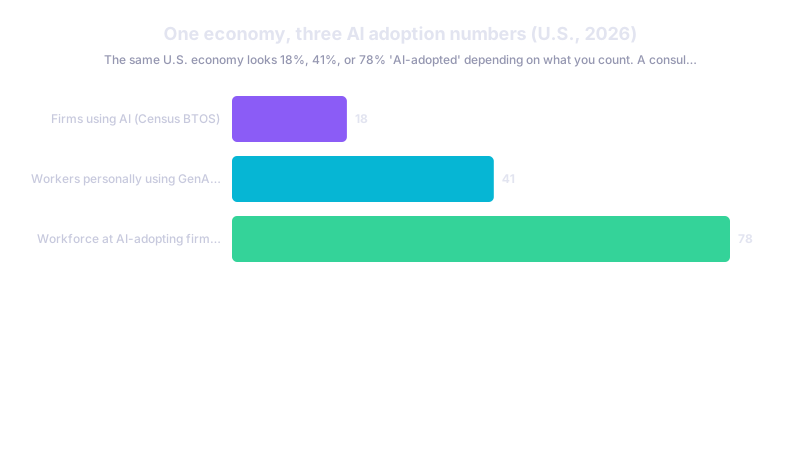
Watch for numbers that sound huge but describe a different world than yours. The same U.S. economy looks 18%, 41%, or 78% "AI-adopted" depending on what you count: about 18% of firms have adopted AI (Census BTOS), roughly 41% of workers personally use generative AI for work (Real-Time Population Survey), and 78% of the labor force works at a firm that has adopted AI (Atlanta Fed Survey of Business Uncertainty) (Federal Reserve, 2026). A consultant who leads with "78% of the workforce already uses AI, you're falling behind" is cherry-picking the scariest framing. Adoption is concentrated in large firms: 37% of businesses with 250+ employees use AI versus under 20% of the smallest firms (U.S. Census Bureau, 2026). You are not an outlier; you are typical.
Red flag 6: They won't give you ownership of accounts, data, and prompts
This is the same trap that plagues hiring a marketing agency, adapted for AI. Ask directly: Who owns the vendor accounts and API keys? Who owns the prompts and any fine-tuned assets? Where does your customer data go, and is it used to train someone else's model? Is there a markup on the underlying AI usage costs, and is it disclosed? A partner who cannot answer these in writing, or who insists on holding your accounts and data hostage, is building dependency rather than capability. Get ownership and data handling in the contract before you sign. If you are also weighing tools, our best AI tools for small business and AI chatbot cost guide give you baseline prices to sanity-check any quote.
What This Means for Your Business
Most small businesses do not need a moonshot; they need one annoying, repetitive task handled reliably and cheaply. The consultants worth hiring will tell you that plainly. They scope a narrow problem, promise efficiency they can measure, favor buying over building, keep the jargon in check, and leave you owning your accounts and data. The ones to avoid lead with fear, revenue fantasies, "agent" hype, and enterprise statistics that have nothing to do with a five-person shop. When in doubt, ask for a small paid pilot with a defined success metric before any long commitment. If the pitch cannot survive that, it was never a fit.
Want a straight, no-hype assessment of where AI actually fits in your operation? Talk to Semark's team or explore our AI and machine learning services.