
AI Adoption by Industry in 2026: Why Construction and Restaurants Are Last
About 18% of U.S. firms had adopted AI by the end of 2025, but that single number hides a huge gap: adoption reaches roughly 33% in professional services and 30% in finance, while accommodation and food services sits at just 8% (Federal Reserve, 2026). Construction is close behind, under 10%. If you run a restaurant, a job site, or a trades business and feel like AI passed you by, the data says you are not imagining it.
Short answer: AI adoption in 2026 tracks the type of work a business does, not how "modern" its owner is. Knowledge-heavy sectors that already run on screens, documents, and data - information (about 37%), professional services (33%), and finance (30%) - adopt AI fastest, while physical-work sectors like accommodation and food services (8%) and construction (under 10%) adopt slowest (Federal Reserve, 2026). The lag is rational, not lazy: AI is best at cognitive and analytical tasks, and much of the value in these trades happens with hands, not keyboards.
The real numbers: adoption ranges from 8% to nearly 40%
The most reliable count of who actually uses AI comes from the U.S. Census Bureau's Business Trends and Outlook Survey (BTOS), which asks a large, representative sample of firms directly. Across late 2025 into 2026, national AI use ran between about 17% and 20% of all businesses, with the national average around 19.8% as of early May 2026 (U.S. Census Bureau, 2026).
The Federal Reserve analyzed the same survey by industry and found a wide spread. As of year-end 2025, roughly 18% of firms had adopted AI overall, but the breakdown looked like this (Federal Reserve, 2026):
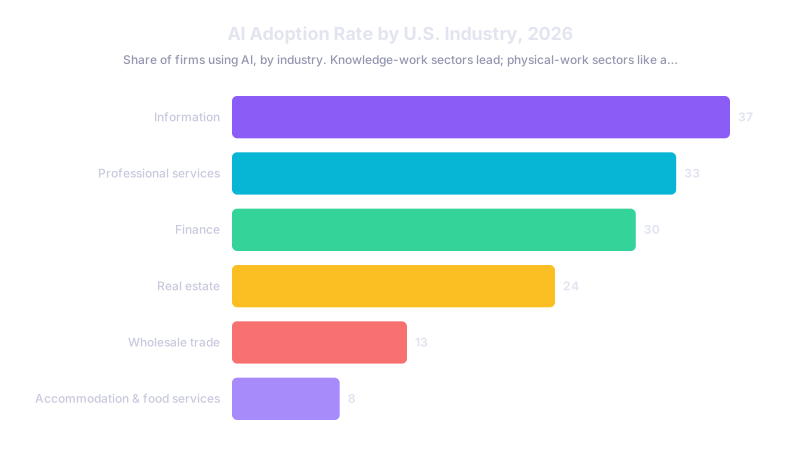
- Information: about 37%
- Professional services: about 33%
- Finance: about 30%
- Real estate and rental and leasing: about 24%
- Wholesale trade: about 13%
- Accommodation and food services: about 8%
Why physical-work industries lag (and why that is rational)
It is tempting to explain the gap by saying restaurant owners and contractors are "behind." The data suggests a simpler reason: current AI is genuinely better at the work these industries do least.
Jeffrey S. Allen, the Federal Reserve economist who authored the central-bank analysis, put it plainly: "This suggests that early AI usage in the U.S. may be skewed towards more cognitive or analytical work, rather than commoditized services" (Federal Reserve, 2026). In other words, AI shines where the raw material is text, numbers, and documents - drafting a contract, summarizing a case file, reconciling a ledger. A framing crew and a line cook produce value with their hands, in the physical world, where today's AI cannot follow.
That does not mean there is nothing for these businesses to automate. It means the highest-value AI use in a restaurant or a trades company usually is not on the shop floor - it is in the office tasks wrapped around the physical work: answering the phone, booking jobs, chasing invoices, and handling the flood of "are you open?" and "can you fit me in?" messages.
The other reason: company size, not just industry
Industry is only half the story. The other half is headcount, and it works against exactly the businesses that dominate construction and food service - small ones.
The Census Bureau found that AI use climbs steeply with company size (U.S. Census Bureau, 2026):
- Firms with 250 or more employees: about 37% use AI
- Firms with 100-249 employees: about 32%
- Firms with fewer than 20 employees: under 20%, with no significant change over the survey period
- Firms with 4 or fewer employees: under 20%
A measurement trap worth knowing before you panic
Before you conclude your industry is hopelessly behind, understand that "AI adoption" is measured in at least three different ways, and they disagree wildly (Federal Reserve, 2026):
| How it is measured | Adoption rate | What it counts |
|---|---|---|
| Firm-weighted (Census BTOS) | about 18% | Share of businesses using AI |
| Employment-weighted (Atlanta Fed) | about 78% | Share of workers at firms that use AI |
| Personal use (Real-Time Population Survey) | about 41% | Workers personally using generative AI for work |
What early adopters actually get: efficiency, not a revenue miracle
If you do adopt, set expectations correctly. Among enterprises already running AI, 66% report productivity and efficiency gains, but only 20% say they are already growing revenue from it - even though 74% hope to (Deloitte, State of AI in the Enterprise, 2026). AI today mostly saves time and cost; it rarely rings the register on its own.
For a restaurant or a contractor, that framing is actually good news, because saved time is money you can see. If an AI phone assistant captures the after-hours booking you used to miss, or drafting software turns a 40-minute quote into a 10-minute one, the payback is concrete and local - not a bet on some future revenue transformation. We walk through where those wins tend to land in simple AI automations for small business and the five AI automation workflows every growing business should implement.
Where a restaurant or trades business should actually start
Because the value is in the office work around the physical work, the best first project is almost always communication. A few grounded starting points:
- Never miss a call or booking. A large share of missed revenue in food service and home services is simply an unanswered phone during a rush or a job. An AI answering assistant can capture the request and hand it off. See can AI replace my receptionist and our voice AI for small business phone calls guide for what is realistic here.
- Turn website questions into booked jobs. A simple site chatbot that answers hours, service-area, and pricing questions and collects contact details deflects repetitive messages - see how to set up a chatbot on your website with no code.
- Speed up the paperwork. Quotes, invoices, and follow-ups are text tasks - exactly where AI is strongest.
What This Means for Your Business
If you are in construction, restaurants, or another hands-on trade, the adoption gap is real but it is not a verdict on you - it reflects that AI is currently best at desk work, and your industry does less of it (Federal Reserve, 2026). That is an opportunity, not a sentence. Because so few of your direct competitors have adopted (under 10% in construction and food service), a small, well-chosen automation around your phone, booking, and paperwork can put you ahead of your local market without any of the hype. Start with the one office task that costs you the most time or the most missed jobs, buy a proven tool rather than building, and measure the hours saved.
Not sure which single automation would pay off fastest for your shop or job site? That is exactly the kind of grounded, no-hype scoping we do at Semark. Explore our AI and machine learning services, see how we work with restaurants and home services, or contact us for a straight answer about what is worth automating in your business - and what is not.


