
Even a well-trained, experienced human inspector misses defects at rates "of 20% to 30%" that are "frequently quoted in the inspection literature," according to a Sandia National Laboratories review of 212 studies (Sandia National Laboratories, 2012). That gap is exactly why manufacturers and product businesses reach for computer vision - cameras plus AI that check every part the same way, every shift. But the marketing promise ("99%+ accuracy, 24/7") and the shop-floor reality are not the same thing.
Short answer: Computer vision for quality inspection is real and works, but it is not magic. In a peer-reviewed 2025 study, a strong deep-learning inspection system scored between 92% and 99% accuracy depending on which station and defect it was checking (Sensors, 2025) - better than the roughly 70-80% of defects a human typically catches (Sandia National Laboratories, 2012), yet still station-specific and dependent on good lighting, good cameras, and ongoing tuning. For most small and mid-size operators, the win is consistency and speed, not a flawless robot inspector.
Why businesses want computer vision in the first place
Human inspection has a well-documented ceiling. "One observation has occurred repeatedly and consistently since the initial investigations of the inspection process - human inspectors are imperfect," wrote Judi E. See in the Sandia National Laboratories literature review (Sandia National Laboratories, 2012). The report notes that error rates of 20-30% are common across many inspection tasks, that mistakes are usually omissions (missing a real defect), and that fatigue, pacing, and monotony make it worse over a shift. Two inspectors often disagree on whether the same part passes.
Computer vision addresses the boring, repeatable part of that problem. A camera does not get tired at hour six, does not flinch under pressure to keep the line moving, and applies the identical standard to part number 1 and part number 10,000. For a business, that translates into fewer escaped defects reaching customers and fewer "why did this pass on the night shift?" arguments.
What the accuracy numbers actually say
Here is where the reality check matters. In a 2025 peer-reviewed study in the journal Sensors, researchers Hong-Dar Lin, Hsiang-Ling Wu, and Chou-Hsien Lin built a deep-learning system to inspect flex-head ratchet wrenches. Its classification accuracy was 99.39% at one station, 98.66% at another, and 92.00% at a third - all on the same product (Sensors, 2025). At the best station it caught 100% of defects (recall) with 98.57% precision.
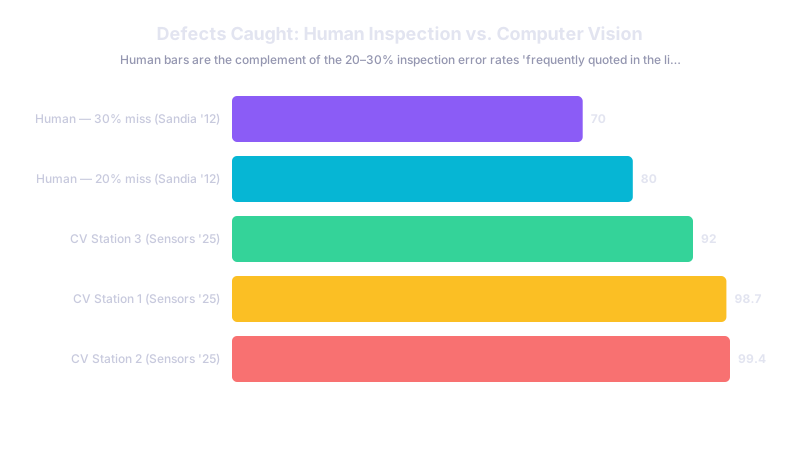
Read that carefully. A published, well-engineered system still swung seven points - from 92% to 99% - depending on the inspection task. That is the honest version of "99% accuracy": it is defect-specific and station-specific, not a blanket guarantee. Vendors quoting a single "99%+" number are describing a best case under controlled conditions. What determines whether your line lands at 92% or 99% is unglamorous: lighting, camera angle, part positioning, and how many good and bad examples you have to train on. Change the lighting and the model's performance can move.
The gap between a demo and a production line
A polished vendor demo is not a running production line. Broad AI research keeps showing the same pattern: adoption and hype run ahead of durable results. Only about 17% to 20% of U.S. businesses reported using AI at all in the latest federal data, and fewer than 20% of the smallest firms (1-4 employees) do, versus 37% of firms with 250 or more employees (U.S. Census Bureau, Business Trends and Outlook Survey, 2026). AI is still an early-adopter tool, concentrated in bigger companies - partly because getting it into production is hard work.
And when companies do deploy AI, the payoff usually shows up as efficiency, not new revenue. In Deloitte's survey of 3,235 business and IT leaders, 66% reported efficiency gains, but only 20% said they were already growing revenue from AI, versus 74% who still hope to (Deloitte, State of AI in the Enterprise, 2026). For quality inspection, that maps cleanly: expect to save inspector-hours and reduce escapes and rework - not to magically sell more product. If a vendor's ROI pitch leans on revenue growth, be skeptical.
Where the money and effort really go
The camera is the cheap part. The real cost of a computer-vision inspection project lives in the parts you do not see in the demo: controlled lighting and mounting, collecting and labeling enough examples of your specific defects, integrating with the line's controls, and the ongoing work of retuning when your product, packaging, or lighting changes. A system that hits 99% in month one can drift when you switch a supplier or a material. Budget for maintenance, not just a purchase.
This is the same build-vs-buy and automate-vs-hire math we cover for other AI tools. If you are weighing an inspection system against adding a person, our guide on when to automate versus when to hire walks through the tradeoffs, and the best AI tools for small business in 2026 covers how to evaluate vendors without getting sold a best-case number.
What This Means for Your Business
Computer vision for quality inspection is a genuine, proven tool - it reliably beats the roughly 70-80% catch rate of a tired human eye and never has a bad shift. But treat "99% accuracy" as a ceiling under ideal conditions, not a floor. The honest expectation for most operators is: strong, consistent, station-specific accuracy in the low-to-high 90s, real savings in inspector time and rework, and a real, ongoing commitment to lighting, data, and tuning. It is an efficiency play, not a revenue miracle.
Start small. Pick one high-volume, high-cost defect on one station, prove the accuracy on your own parts, and expand only after it holds up over weeks - not in a one-afternoon demo. If you want a straight, no-hype assessment of whether computer vision fits your line, our team can help you scope a realistic pilot. Learn more about our AI and machine learning services, or get in touch to talk through your specific inspection problem.