
Investors have poured $227 million into AI-visibility tracking tools, fueling a fast-growing cottage industry of GEO vendors (Kevin Indig, Growth Memo, reported by Digiday, 2026). That much money attracts real partners and opportunists in equal measure, so buyers need a filter.
Short answer: To choose a GEO (generative engine optimization) agency, pick the one that treats AI-search visibility as roughly 80% strong fundamental SEO plus content structured for citation, not a secret "AI hack." Reject any vendor that guarantees rankings or citations in ChatGPT, Perplexity, or Google AI Overviews, because AI answers are unstable: a SparkToro study of 2,961 prompt runs found a less-than-1-in-100 chance the same prompt returns the same brand list twice (Fishkin & O'Donnell, SparkToro, 2026). Demand GEO-specific case studies (AI mentions, citations, and referral traffic, not vague "AI ranking" scores), confirm they audit your SEO foundations first, and expect ongoing work priced like a real retainer.
What a GEO agency actually does
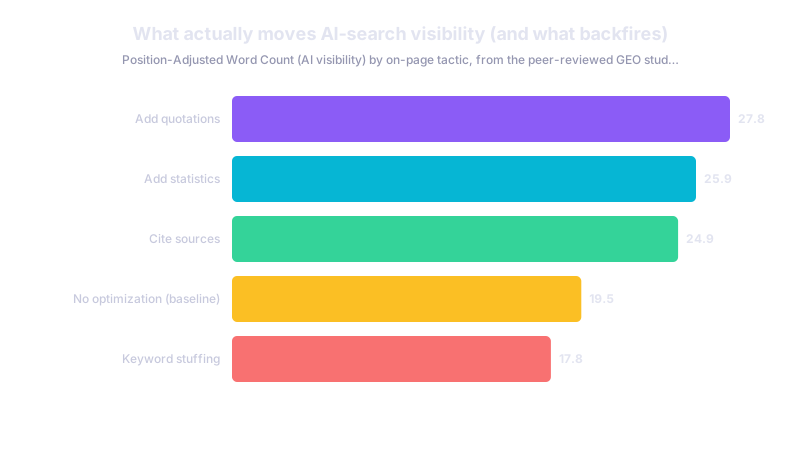
Generative engine optimization is the work of making your site the source that AI answer engines cite, not just a page that ranks. Crucially, it builds on SEO rather than replacing it. The best evidence for what actually moves the needle comes from the peer-reviewed GEO study out of Princeton and Georgia Tech (Aggarwal et al., ACM KDD 2024). Across their benchmark, the on-page tactics that lifted AI visibility most were adding quotations, adding statistics, and citing sources: quotation addition scored 27.8 on the study's Position-Adjusted Word Count metric versus a 19.5 baseline, with statistics addition at 25.9 and citing sources at 24.9. The paper reports gains of "up to 40%" overall, but stresses that efficacy varies by domain, so treat these as upper-bound signals from a synthetic academic benchmark, not guarantees on your local-service queries. Notably, keyword stuffing scored below baseline at 17.8, confirming that old-school tricks backfire in AI answers.
Off-page, the biggest lever is earned brand mentions. Ahrefs' study of 75,000 brands found web mentions correlate with AI Overview visibility at 0.664, far ahead of backlinks at 0.218; brands in the top mention quartile averaged 169 AI Overview mentions versus 14 for the next quartile down, more than a 10x gap (Ahrefs, "AI Overview Brand Visibility Factors", May 2025). A credible agency audits your schema, page structure, entities, and content gaps before recommending anything AI-specific. For the fundamentals, see how generative engine optimization actually works for small businesses.
Red flags: how to spot GEO snake oil
The single fastest disqualifier is a guarantee. No agency controls proprietary, constantly changing models, so guaranteed rankings or citations in AI answers are impossible to promise. Watch for hype language ("instant AI rankings," "exclusive GEO tactics," "secret AI methods") that never explains the actual work. Be especially wary of any dashboard selling a fixed "AI ranking position." As Rand Fishkin, co-founder of SparkToro, put it after his team's research:
But, any tool that gives a "ranking position in AI" is full of baloney.
The other tell is a vendor who ignores or disparages SEO foundations. Jeremy Moser, co-founder and CEO of SEO agency uSERP, framed it bluntly:
The 80/20 of GEO is simply just good traditional SEO. If a GEO service does not openly tell you that success in AI visibility is 80 percent good fundamental SEO, they are selling you snake oil.
Finally, distrust case studies that list GEO as a service but show zero GEO-specific outcomes. For a broader checklist, see our guide to red flags when hiring a marketing agency.
Questions to ask before you sign
Put these four questions to any shortlist:
- Which page types, schema, and content gaps will you fix first, and how does that map to AI citation?
- How do you measure AI visibility across ChatGPT, Perplexity, and Google AI Overviews, and how do you separate correlation from causation?
- Can you show GEO-specific case studies with AI mentions, citations, and referral traffic, not just organic rankings?
- How do you avoid tactics like mass synthetic FAQs and scaled thin content that can damage the very SEO that feeds AI answers?
What GEO should cost in 2026
Legitimate GEO rides on real SEO and content retainers, because the work is ongoing testing, content, and authority-building. In our experience, most credible engagements land somewhere in the low-thousands to low-tens-of-thousands per month depending on scope and market competitiveness (this is our internal estimate, not a published benchmark). Because investors have put $227 million into AI-visibility tools (Kevin Indig, Growth Memo, via Digiday, 2026), expect tool costs to be bundled or itemized in your retainer. Building the same capability in-house, with a full SEO and content team, is materially more expensive than a retainer for most small and growing businesses. The trap to avoid is pricing that looks like a cheap "AI add-on"; durable AI visibility is not a one-time toggle.
How to measure whether it's actually working
Track brand mentions and citations inside AI answers, plus AI referral traffic, not a single "AI rank." Expect volatility: SparkToro's 2,961-run study found the same prompt rarely returns the same brands, yet across many runs the top brands per category still appeared in 55-77% of responses (SparkToro, 2026). That means you judge trends over many runs, not one screenshot. Tie any visibility gains to business outcomes: leads, calls, and conversions from AI-referred users. And confirm the work is human-led: Graphite found 82% of articles cited by ChatGPT and Perplexity, and 86% of top Google-ranking articles, are human-written (Graphite, "AI Content in Search & LLMs", data June 2025). The stakes are real, because AI Overviews now correlate with a 58% lower average click-through rate for the top-ranking page (Ahrefs, February 2026), which is exactly why being cited inside the AI answer matters.
What This Means for Your Business
The GEO market is a gold rush with real vendors and opportunists mixed together, and your filter is simple: fundamentals-first, evidence-backed, and honest about volatility. Hire a partner who audits your SEO first, reports AI citations and referral traffic, and refuses to guarantee rankings. If a pitch leans on secret hacks or guaranteed AI placement, walk away. Semark's take: pay for a durable content-and-authority engine, not a vanity dashboard number. If a vendor won't admit that roughly 80% of the work is fundamentals, that admission alone is your cheapest disqualifier.
Want a GEO partner that fixes fundamentals first and reports real AI citations, not vanity scores? Talk to Semark or explore our generative engine optimization service.