
A prospective patient searches "best dermatologist near me." They see your Google Business Profile with 4.8 stars and 120 reviews. Then they check Healthgrades and find three reviews from 2019. Which profile shapes their decision? The answer determines where you should focus your reputation management effort.
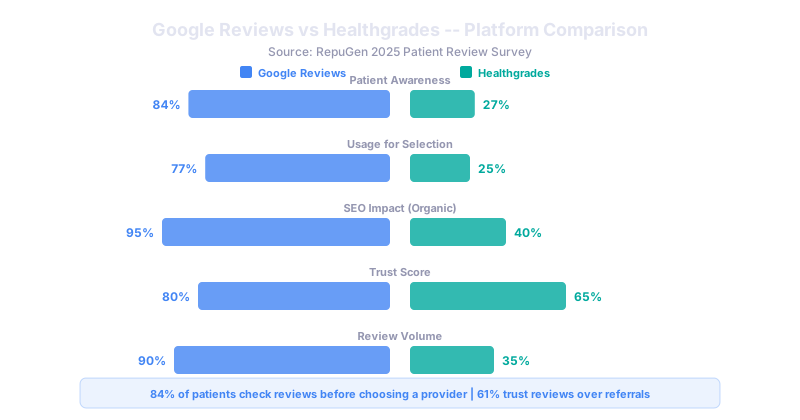
Short answer: Google Reviews matter more for patient acquisition. RepuGen's 2025 Patient Review Survey shows Google has 84% patient awareness compared to Healthgrades at 27%. However, 40% of patients check multiple platforms before choosing a provider, so ignoring Healthgrades entirely is a mistake. Prioritize Google at 70% of your effort and maintain a presence on Healthgrades with the remaining 30%.
The Numbers: Google Dominates, But Healthgrades Still Matters
Google's awareness among patients rose to 84.03% in 2025, up from 81.96% in 2024. More importantly, 77% of patients actively use Google when deciding where to go for care. Healthgrades sits at 26.79% awareness, up modestly from 25.89% the year before.
The trust gap is significant: 84% of patients check online reviews before choosing a provider, and 61% trust reviews more than personal referrals. Google captures the majority of that review-checking behavior simply because it is embedded in the search process. When someone searches for a doctor, Google reviews appear before they ever reach a dedicated review site.
Where Google Wins
Google Reviews have three structural advantages. First, they appear directly in search results and map packs, meaning patients see them without clicking through to a separate site. Second, review volume on Google far exceeds any healthcare-specific platform because every Google user can leave a review. Third, Google reviews directly influence local search rankings, so more positive reviews improve your visibility to new patients.
The SEO impact alone makes Google the priority. Practices with consistent review generation on Google rank higher in the local map pack, which drives the majority of "near me" healthcare searches.
Where Healthgrades Wins
Healthgrades serves a different function. Patients who visit Healthgrades are further in the decision-making process. They already know they need a doctor and are comparing specific providers. Healthgrades provides detailed credential verification, accepted insurance information, and condition-specific ratings that Google does not.
The 2025 data shows a pattern of gradual consolidation around established healthcare platforms. Healthgrades grew 0.9% year-over-year, and WebMD grew 3.72%, suggesting patients increasingly distinguish between general review platforms and healthcare-specific sources. Patients use Google for discovery and Healthgrades for validation.
The Multi-Platform Strategy
Since 40% of consumers consult reviews on multiple platforms before making a decision, consistency across platforms matters as much as volume on any single one. A practice with 200 Google reviews and zero Healthgrades reviews looks suspicious to the patient who checks both.
Your approach should be straightforward. After every positive in-office interaction, send a review request link to Google first. For patients who mention they found you on Healthgrades, ask them to leave a review there. Respond to all reviews on both platforms within 48 hours, positive and negative. Keep your Healthgrades profile updated with current photos, accepted insurance, and office hours.
What This Means for Your Practice
Invest 70% of your reputation management effort in Google Reviews because that is where patients discover you. Invest 30% in Healthgrades because that is where patients validate their choice. The combination covers both stages of the patient decision journey.
Do not spread yourself thin across ten platforms. The data shows consolidation, not fragmentation. Google and one to two healthcare-specific platforms cover where the vast majority of patients look.
Related reads:
- HIPAA-Compliant Email Marketing: What You Can and Can't Do
- How to Reduce No-Shows with Appointment Reminders
Want a review generation system that works across platforms? We build automated reputation management systems for healthcare practices that drive consistent review volume on the platforms that matter. Get started.
