
A patient books an appointment three weeks out. Life happens. They forget. Your 2:00 PM slot sits empty, and the revenue is gone. Multiply that across 15-20% of your weekly appointments, and no-shows become one of the largest drains on practice profitability.
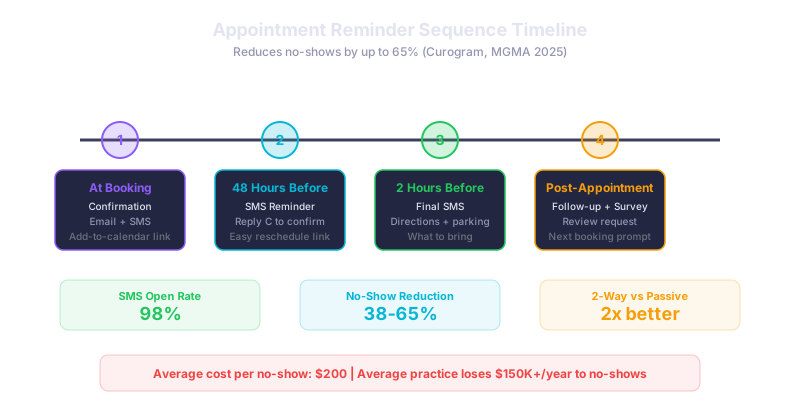
Short answer: Automated appointment reminders reduce no-show rates by 38-65% across all healthcare settings. The most effective approach uses a multi-touch sequence: confirmation at booking, an SMS reminder 48 hours before, a final text 2 hours before, and a post-appointment follow-up. SMS reminders outperform email by nearly 5x due to a 98% open rate versus email's 20-30%.
The No-Show Problem by the Numbers
Primary care practices typically see no-show rates of 12-18%, while specialty practices run 20-25%. Mental health services face the steepest challenge at 30-45%. The cost per no-show averages $200 in lost revenue, and the average practice loses over $150,000 annually to missed appointments (MGMA's 2025 survey).
These are not just financial losses. No-shows disrupt scheduling for other patients, reduce staff productivity, and in many cases delay necessary care for the patient who missed.
The Reminder Sequence That Works
Medical practice leaders who maintained or improved no-show rates in 2025 most often credited consistent patient communication, particularly frequent digital reminders combined with occasional live outreach (MGMA).
The evidence-backed sequence follows four touches. First, send a confirmation immediately at booking via both email and SMS, including an add-to-calendar link. Second, send an SMS reminder 48 hours before with two-way confirmation. Requiring active engagement, like replying "C" to confirm, is far more effective than passive notifications. Third, send a final SMS 2 hours before the appointment with directions, parking information, and what to bring. Fourth, follow up after the appointment with a satisfaction survey and a prompt to book the next visit.
Practices implementing this structured system have reduced no-shows from 23% to 8% within six months, representing a 65% improvement (Curogram 2025).
Why SMS Beats Every Other Channel
SMS messages carry a 98% open rate with 90% read within 3 minutes of delivery. Email reminders have a 20-30% open rate and are often buried in inboxes. Phone call reminders work but require staff time and reach voicemail more often than a live person.
The data from Dialog Health shows that SMS reminders alone reduce non-attendance rates by 38% on average. When combined with two-way confirmation that requires an active response, the reduction jumps significantly higher because patients who actively confirm are psychologically committed to attending.
Handling Chronic No-Shows
Some patients will still miss appointments despite reminders. For this population, consider predictive outreach. A 2023 study published in the Journal of General Internal Medicine found that live appointment reminders targeted at high-risk patients through predictive modeling significantly reduced no-show disparities.
Other proven tactics include implementing a waitlist system to fill cancelled slots within minutes, offering same-day or next-day scheduling for patients with a history of no-shows, and charging a nominal no-show fee. MGMA reported that no-show fees in medical practices are on the rise as more practices balance attendance accountability with patient relationships.
What This Means for Your Practice
The practices with the lowest no-show rates all share one trait: they automate the reminder process rather than relying on front-desk staff to make calls. Automation ensures every patient gets every touchpoint without burdening your team.
Start with SMS-based reminders on a 48-hour and 2-hour cadence. Add two-way confirmation. Measure your baseline no-show rate for 30 days, implement the system, and measure again. Most practices see a 30-60% reduction within three months.
Related reads:
- HIPAA-Compliant Email Marketing: What You Can and Can't Do
- Google Reviews vs Healthgrades: Which Matters More for Doctors?
Ready to cut no-shows and reclaim lost revenue? We build automated reminder and patient communication systems for healthcare practices using proven process automation. Let's talk.
