
If you read AI vendor blogs, you would think every business on your street is already running on artificial intelligence. The actual number, measured by the government agency that surveys hundreds of thousands of US firms, is 19.8% (US Census Bureau, May 2026). Among the smallest businesses - those with four or fewer employees - it is under 20% (US Census Bureau, 2026).
Short answer: As of 2026, roughly one in five US businesses uses AI in producing goods or services, according to the US Census Bureau's Business Trends and Outlook Survey. Adoption climbs steeply with company size - about 37% at firms with 250+ employees versus under 20% at firms with four or fewer employees. The "everyone is using AI" narrative comes from counting differently (by employees or by individual workers), not from a different reality on Main Street.
This post uses primary government sources - the US Census Bureau and the Federal Reserve - instead of vendor surveys, because the gap between the two is the whole story.
The Headline Number: About 1 in 5 Firms
The US Census Bureau runs the Business Trends and Outlook Survey (BTOS), a large, recurring survey of US employer firms. In its May 2026 release, overall AI adoption sat at 19.8%, ranging between roughly 17% and 20% across recent survey waves, with another 20-23% of businesses expecting to adopt AI within the following six months (US Census Bureau, May 2026).
The Federal Reserve's own analysis lands in the same place: a FEDS Note by Federal Reserve economist Jeffrey S. Allen reports that 18% of firms had adopted AI by the end of 2025 (Federal Reserve, April 2026). Two independent government datasets, roughly the same answer. That is about as close to ground truth as business statistics get.
So when a vendor deck claims "80% of businesses are adopting AI," they are almost never talking about the share of firms actually using it in production. They are usually counting something else - which we will get to.
Size Is the Real Dividing Line
The single most useful fact for a small business owner is that adoption is driven overwhelmingly by headcount:
| Firm size | Currently using AI |
|---|---|
| 4 or fewer employees | Under 20% |
| 100-249 employees | 32% |
| 250+ employees | 37% |
The trend data sharpens the point. Between December 2025 and May 2026, the Census Bureau found that "AI use increased among firms with at least 20 employees but didn't change significantly among firms with fewer than 20 employees" (US Census Bureau, 2026). In other words, the growth you keep hearing about is happening at mid-sized and large companies. The smallest businesses - the plumbers, clinics, law offices, and restaurants that make up most of the economy - have largely stayed put.
That is not a knock on small businesses. It reflects something real: big firms have dedicated staff, budgets, and repeatable high-volume workflows that justify the setup cost. A four-person shop does not. If you run a small business and have not adopted AI yet, you are with the majority, not behind it.
Why Some Surveys Say 80% and the Census Says 20%
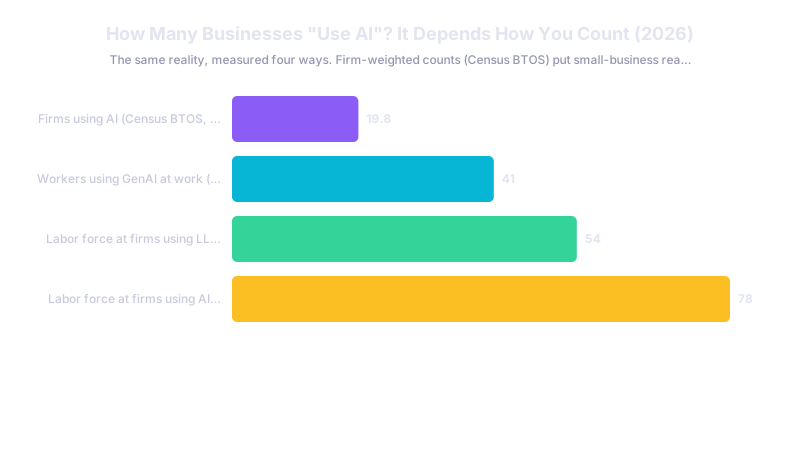
Here is the part almost no vendor article explains. "How many businesses use AI" has at least three legitimate answers depending on what you count, and the Federal Reserve laid them side by side:
- Firm-weighted (BTOS): ~18-20% of firms use AI. Every business counts once, so the millions of tiny firms that dominate the count pull the number down.
- Employment-weighted (Atlanta Fed Survey of Business Uncertainty): 78% of the US labor force works at a firm that uses AI, and 54% work at a firm using large language models specifically (Federal Reserve, April 2026). Big employers count for more people, so the number jumps.
- Individual workers (Real-Time Population Survey): 41% of the workforce reported using generative AI at work as of November 2025, 50% used it outside work, and 12% used it daily at work (Federal Reserve, April 2026).
For a small business owner, the honest read is this: your employees may already be using ChatGPT on their own, but your company probably has not adopted AI into its actual operations. Those are different things, and closing the gap between them is where the practical opportunity lives.
Which Industries Are Actually Ahead
Adoption also splits sharply by sector. From the Census Bureau's 2026 data:
- Information: 39.7%
- Finance and Insurance: 33.9%
- Retail Trade: ~14% (below the national average)
If you are in law, accounting, insurance, marketing, or another knowledge-work field, you are in the sectors where AI is already changing baseline expectations - worth taking seriously. If you are in a trade or hospitality business, you have more room to move at your own pace, and simple, targeted automations tend to beat sweeping "AI transformation."
Adoption Is Not the Same as Working
A firm can "adopt" AI and still get nothing out of it. Two more datasets keep the picture honest.
First, most usage stops well short of production. MIT's NANDA initiative, in its preliminary State of AI in Business 2025 report, found that for custom, task-specific generative AI tools, roughly 60% of organizations evaluated them, about 20% ran a pilot, and only about 5% reached production - while general-purpose tools like ChatGPT and Copilot moved from pilot to implementation about 83% of the time (MIT NANDA, 2025). (That report is preliminary and non-peer-reviewed, based on a small interview and survey sample, and its authors call it "directionally accurate" - so treat the exact figures as indicative, not gospel.) The practical lesson survives the caveats: buying and lightly using off-the-shelf tools works far more often than commissioning a custom build.
This is also the real story behind the viral "95% of AI projects fail" headline you may have seen. That number is folklore created by loose paraphrasing of the same MIT report - it describes custom pilots that never reached production for some businesses, not a 95% failure rate for AI in general. Do not let it scare you off, and do not let anyone use it to sell you an expensive "we'll do it right" engagement.
Second, when AI does deliver, it usually shows up as efficiency, not revenue. Deloitte's State of AI in the Enterprise (surveying 3,235 leaders, January 2026) found 66% reported efficiency or productivity gains, but only 20% said AI was already growing revenue - versus 74% who hoped it would (Deloitte, 2026). Set your expectations accordingly: AI is far more reliable at saving time than at printing money.
A Note on "Just Buy It" vs. "Build It"
One widely cited enterprise figure is worth borrowing carefully. Menlo Ventures' State of Generative AI in the Enterprise (n=495, December 2025) found that 76% of AI use cases were purchased rather than built in-house, up from a near-even split in 2024 (Menlo Ventures, 2025). That is enterprise data - companies with real engineering teams - and even they concluded that buying beats building. For a small business, the implication is even stronger: your first AI move should almost never be a custom development project. Start with proven, off-the-shelf tools. Our guide to the best AI tools for small business in 2026 is a good starting point.
The same report found that only about 16% of enterprise "AI agent" deployments were true autonomous agents; most of what gets marketed as an "agent" is simpler automation (Menlo Ventures, 2025). If you are being pitched an "AI agent," it is worth understanding what AI agents really are and how small businesses can use them before you sign anything.
What This Means for Your Business
The government data cuts through the noise:
- You are not behind. Four out of five of the smallest US firms have not adopted AI, and adoption among sub-20-employee firms did not meaningfully grow in early 2026 (US Census Bureau, 2026). This is an on-ramp, not a missed exit.
- Distrust "everyone is using AI" claims. They usually rely on employee-level or employment-weighted counts (41% and 78% respectively per the Federal Reserve, April 2026), not the ~20% of firms that have actually adopted it.
- Buy before you build. Even enterprises purchase most of their AI (76%, Menlo Ventures 2025). Off-the-shelf general-purpose tools reach production far more reliably than custom projects (MIT NANDA, 2025).
- Expect time savings, not a revenue miracle. Only 20% of organizations are already seeing AI grow revenue (Deloitte, 2026). Efficiency is the near-term win.
If you want help separating what is real from what is hype for your specific operation, that is exactly what we do. Talk to us about AI and machine learning for your business, or get in touch for a straight, no-pressure assessment.