
The primary category on your Google Business Profile is the single most influential local-pack ranking factor in the field (Whitespark, 2026), and HVAC search demand swings up to 266% between summer and winter (WebFX, 2025). Get the profile right in the off-season and you own the map pack before the next heatwave or cold snap sends demand through the roof.
Short answer: To rank for furnace and AC repair in your city, get three things right: a Google Business Profile with the correct primary category (the #1 local-pack ranking factor per Whitespark's 2026 Local Search Ranking Factors survey), individual service-area pages for each city and each service you cover, and a steady flow of recent, keyword-rich Google reviews. Because HVAC demand swings up to 266% between summer and winter (WebFX, 2025), you build the rankings in the off-season so you already sit on page one before the season hits.
Why HVAC is one of the hardest local SEO games to win
HVAC demand is brutally seasonal, and that changes how you have to play. According to WebFX's analysis of Ahrefs Keywords Explorer data, U.S. searches for "AC repair" peak in July at roughly 91,690 per month and bottom out in February at about 25,027 - a +266% swing (WebFX, 2025). "Furnace repair" runs the mirror image, peaking in January near 62,392 searches, a +137% jump over its off-season floor (WebFX, 2025).
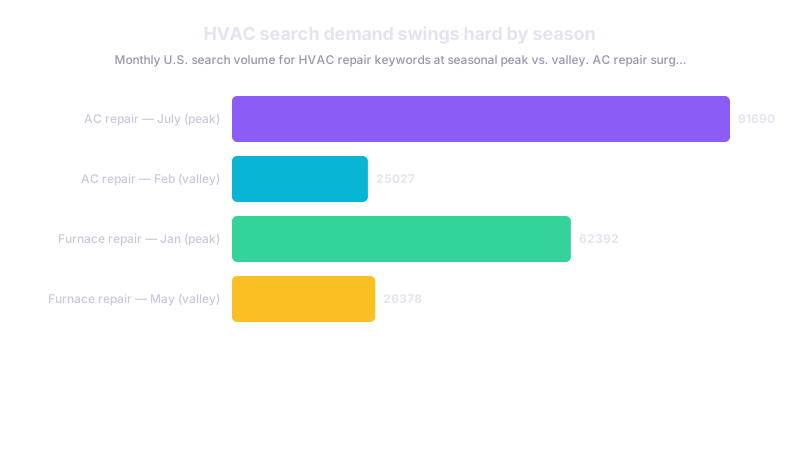
Here's the problem that trips up most contractors: rankings take months to build, but demand arrives in a matter of days when the weather turns. You cannot start optimizing in July and expect to catch the summer wave. By the time your pages gain traction, the heat has broken and the searches have moved on. The winning move is inverted - you build in February and September so the rankings are already in place when the curve spikes.
Paid search does not bail you out either. The average cost per click for HVAC keywords was $29.03 in 2024 and rose to a projected $32.77 in 2025 (WebFX, 2025). When a single click costs more than $32 and every competitor in town is bidding on the same "AC repair near me" term during peak season, organic and local-pack visibility become disproportionately valuable - they keep producing leads without the per-click tax.
And position is everything. The homeowner with no heat at 6 p.m. in January is not comparison shopping. They open the map pack, glance at the top three results, and call one. If you are not in that top three, you do not exist for that job.
Start with the Google Business Profile - it's the #1 lever
If you do only one thing, do this. In Whitespark's 2026 Local Search Ranking Factors survey, the primary Google Business Profile (GBP) category is the single most influential local-pack ranking factor. Proximity of the searcher to your business address ranks #2, and keywords in the GBP business title rank #3 (Whitespark, 2026). You cannot move your address closer to every searcher, but you can absolutely nail your category - and it is free.
Choose the most specific primary category that describes your core business, such as "HVAC contractor" or "Furnace repair service," then add secondary categories for each additional service you offer. Specificity matters more than breadth: a precise primary category tells Google exactly which searches you belong in.
As Jensen Savage, CEO and founder of Savage Growth Partners, puts it, a well-maintained Google Business Profile is "one of the highest-leverage assets for local trust and conversions." That maintenance is ongoing, not a one-time setup. Keep your name, address, and phone number (NAP) identical everywhere they appear online, post real photos of your crew and completed jobs, list your services, and reply to reviews regularly. These signals reinforce relevance and trust.
For the full step-by-step, see our Google Business Profile optimization guide.
Build a service-area page for every city AND every service
One generic "service areas" page will not cut it, and neither will a single page trying to cover both furnace and AC work across a dozen towns. You want a dedicated page for "AC repair in [City]" and a separate page for "Furnace repair in [City]" - matching the way homeowners actually search.
The catch is that these pages have to be genuinely local, not thin templates with the city name swapped in. Google filters out doorway pages - near-identical pages that exist only to target different city keywords - so a page that just find-and-replaces "Austin" with "Round Rock" adds no value and can drag your whole site down under the helpful-content system.
Real service-area pages earn their rankings with content only a local operator can write: the neighborhoods and subdivisions you serve, local climate and permitting notes, real project photos from that area, and reviews from customers in that city. Interlink each page to your Google Business Profile and to your related service pages so the whole cluster reinforces itself. Our guide to service-area pages that survive Google's helpful-content filters walks through a structure that holds up.
If you want the broader framework these pages sit inside, our local SEO guide for service businesses ties the GBP, citations, and site structure together.
Reviews, seasonality, and the content calendar
Reviews are a ranking factor and a conversion factor at the same time. The number of native Google reviews with text lands in the top 10 of Whitespark's 2026 local-pack factors (Whitespark, 2026), and reviews with actual written detail carry more weight than a bare star rating. The practical habit: ask for a review after every completed job, while the relief of a fixed furnace is still fresh.
Then time everything to the demand curve. Publish seasonal content ahead of demand, not during it - furnace maintenance and repair guides in early fall, AC guides in spring - so the pages are indexed and ranking by the time searches climb. Line up your review-generation pushes and GBP posts the same way, building momentum in the shoulder months so it crests right as search volume does.
The mental model is simple: the off-season is for building rankings, and the in-season is for harvesting the leads those rankings produce. Contractors who invert that - going quiet in the off-season and scrambling in July - pay more for less.
Don't ignore AI search - it's now part of local discovery
Search results increasingly open with an AI-generated answer, and that changes the click math. Ahrefs found that when an AI Overview appears, the top-ranking organic result now sees a 58% lower average click-through rate than it did before AI Overviews (Ahrefs, December 2025). Pew Research Center's data points the same direction: users clicked a traditional search result in just 8% of visits when an AI summary was present, versus 15% when it was not (Pew Research Center, 2025). (Google has disputed Pew's methodology, so treat it as directional.)
That makes it more important to be the source the AI cites, and to show up in the map pack that sits above the AI answer for local queries. Two things help. First, brand presence off your own site: Ahrefs' study of 75,000 brands found that brand web mentions correlate with AI Overview visibility far more strongly than backlinks do - 0.664 versus 0.218 - and the most-mentioned quartile of brands averaged about 169 AI Overview mentions against roughly 14 for the next quartile (Ahrefs, May 2025). For an HVAC company, that means local PR, chamber-of-commerce listings, sponsorships, and citations across local directories.
Second, on-page structure. In the "GEO: Generative Engine Optimization" study (Aggarwal et al., ACM KDD 2024), the authors report that their "top-performing methods, namely Cite Sources, Quotation Addition, and Statistics Addition, achieved a relative improvement of 30-40% on the Position-Adjusted Word Count metric" for AI-search visibility - a headline gain of up to about 40%. Two honest caveats: those figures come from a synthetic academic benchmark, not from local-service queries, and the paper itself found the effect depends heavily on the domain, so treat the numbers as an upper bound rather than a promise. (Notably, keyword stuffing performed worse than the baseline in the same study - so that old tactic actively hurts.)
The takeaway for a contractor is practical: structure each page so an AI can extract a clean answer - a clear statement of the service, the city, a price range, and your hours - and back your claims with sources and specifics. Our guide to optimizing for Google's AI Overviews as a small business goes deeper.
What This Means for Your Business
Fix the Google Business Profile primary category and your review flow first. It is the highest-ROI move on this list, it maps directly to the #1 and top-10 local-pack ranking factors (Whitespark, 2026), and it costs nothing but attention.
Build real, distinct service-area pages - one per city and per service - before your busy season, not during it. Because demand swings up to 266% (WebFX, 2025) and rankings take months to earn, the off-season is when page-one positions are cheapest to win.
Treat AI search as a new front door rather than a threat. With AI Overviews cutting clicks on the top result by 58% (Ahrefs, December 2025), the winners will be the businesses that earn local mentions and structure their pages so an AI can quote them cleanly.
Want to own the map pack for furnace and AC repair in your city before the next season hits? See how we help HVAC contractors at /industries/home-services/hvac, or get a plan.
