
Chiropractors treat more than 35 million Americans a year, and there are only about 70,000 of them to do it (American Chiropractic Association). That is a lot of demand chasing a limited number of practices, yet plenty of chiropractors still have gaps in the schedule. The reason is almost always the same: patients cannot find them at the moment they are looking, or they find them and see no reviews. With 97% of consumers reading online reviews before choosing a local business (BrightLocal, 2026), filling the book is now a local-search and reputation game more than an advertising one.
Short answer: The most reliable way for a chiropractor to fill the appointment book is to win local search where patients actually look - a fully completed Google Business Profile ranking in the Map Pack, a steady flow of recent Google reviews, and location-specific pages on your site. Roughly 35 million-plus Americans seek chiropractic care each year against about 70,000 chiropractors (American Chiropractic Association), and 97% of consumers read reviews before choosing a local business (BrightLocal, 2026), so proximity, reviews, and profile completeness decide who gets the call.
Chiropractic is won or lost in local search
The demand is real and it is enormous. Chiropractors treat more than 35 million Americans annually against a workforce of roughly 70,000 licensed practitioners (American Chiropractic Association). Satisfaction is high too - three in four people who see a chiropractor (77%) describe the care as "very effective" (American Chiropractic Association). So the marketing problem is rarely convincing people that chiropractic works. It is getting in front of the person who is searching "chiropractor near me" with a stiff neck at 8 a.m., ready to book that day.
That intent is what makes chiropractic different from most healthcare marketing. It is hyper-local, high-urgency, and usually mobile. Someone in pain is not researching brands for a week; they are picking from whoever shows up nearby with good reviews and an open slot. Because the intent is geographic rather than brand-driven, a solo or small practice can out-rank a hospital system for local queries. The chain does not get a proximity advantage in your neighborhood - you do.
The funnel is short and worth memorizing: search → Map Pack → reviews → website → booked appointment. Every section below is about removing friction at one of those steps. Get all five right and the schedule fills itself; break any one link and you leak patients to the practice down the street.
Own the Map Pack with your Google Business Profile
Your Google Business Profile is the single highest-leverage free asset a local practice has. It is what populates the map and the three-result "Map Pack" that sits above the regular links, and it is where 71% of consumers go to read reviews (BrightLocal, 2026). For a chiropractor, that profile is often where the decision actually gets made - before anyone visits your website.
Completeness and accuracy do the heavy lifting. Fill every field: correct primary and secondary categories (Chiropractor, plus relevant service categories), an accurate service list, hours, and real photos of the office and staff. Add your specific services - spinal adjustments, sports-injury care, prenatal chiropractic, auto-injury rehab - because those service entries help you surface for more specific searches. Keep the profile active with posts and by answering questions in the Q&A section; a profile that looks maintained signals an open, responsive practice.
Consistency off the profile matters too. Your name, address, and phone number (NAP) should be identical across your website, directories, and health listings, because conflicting information undercuts the trust signals Google uses to rank you locally. For the full field-by-field walkthrough, see our Google Business Profile optimization guide.
Reviews are the currency of trust
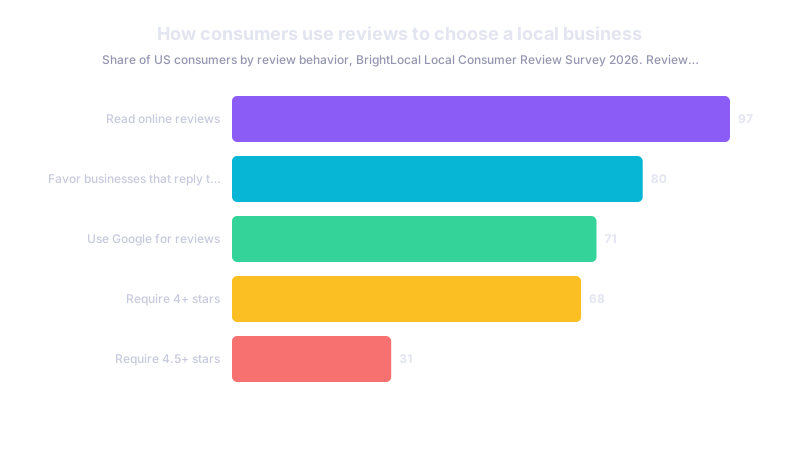
Reviews are not a nice-to-have; they are the deciding factor. 97% of consumers read online reviews for local businesses, 68% will only use a business with four or more stars, and 31% will only consider one rated 4.5 stars or higher (BrightLocal, 2026). A chiropractor with three reviews is invisible next to one with eighty, no matter how good the care.
The fix is a simple, repeatable ask. Build an after-visit routine that sends a short automated text or email to satisfied patients right after a good appointment, with a one-tap link to your Google profile. Timing beats cleverness here - the request lands while the relief is fresh.
Then respond to everything. 80% of consumers say they are likely to use a business that responds to all of its reviews (BrightLocal, 2026), so owner responses are themselves a marketing asset, not just customer service. (Keep responses HIPAA-appropriate - thank people and address concerns without confirming clinical details or that someone was a patient.) What wins is the combination: volume, recency, and visible owner engagement together beat a single high star count sitting untouched. For a practical playbook, see how to get more five-star reviews.
Get found in AI search, not just Google
More patients now start with an AI answer before they ever click a link - asking ChatGPT or reading a Google AI Overview for "best chiropractor in [city]." That shift has teeth: the presence of an AI Overview now correlates with a 58% lower average click-through rate on the #1 organic result (Ahrefs, Dec 2025). Being the practice the AI names or cites is starting to matter more than owning the top blue link.
The signals that earn those mentions overlap heavily with local SEO, which is convenient. In a study of 75,000 brands, brand web mentions correlated with AI Overview visibility at 0.664, far ahead of backlinks at 0.218 (Ahrefs, May 2025). In plain terms: getting named across local news, directories, and health sites moves the needle more than traditional link building. The same reputation footprint that helps your Map Pack rank also helps machines recommend you.
On your own pages, how you write matters too. In the academic GEO (Generative Engine Optimization) study, the top-performing methods - Cite Sources, Quotation Addition, and Statistics Addition - achieved a relative improvement of 30-40% on the study's visibility metric, up to 40% overall (Aggarwal et al., ACM KDD 2024). As the paper's lead author put it:
"Our top-performing methods - Cite Sources, Quotation Addition, and Statistics Addition - achieved a relative improvement of 30-40% on the Position-Adjusted Word Count metric... the efficacy of these strategies varies across domains, underscoring the need for domain-specific optimization methods." - Pranjal Aggarwal, lead author, GEO: Generative Engine Optimization (ACM KDD 2024)
Treat that as directional, not gospel: those figures come from a synthetic academic benchmark, not from local chiropractic queries. But the takeaway is sound and low-risk - pages that cite sources, quote experts, and include real statistics tend to get pulled into AI answers more readily. For more, see our guide on optimizing for Google AI Overviews.
Turn a website visitor into a booked appointment
Reviews and the Map Pack earn the click. The website has to convert it, and this is where a lot of otherwise-good marketing quietly fails. A patient in pain, on a phone, will not fight your site to book.
Make online booking obvious and mobile-first - a visible "Book Now" button above the fold, the fewest possible steps, and clear insurance and pricing information so nobody has to call to find out whether you take their plan. Every extra field and every "call us during business hours" is a place where a same-day patient bounces to a competitor.
Location and service pages capture the specific, high-intent searches your profile alone cannot. Dedicated pages for "sports chiropractor," "prenatal chiropractic," "auto-injury chiropractor," and individual neighborhoods let you rank for the exact phrase a patient types and land them on a page that speaks directly to their problem. Then measure what matters: track cost per new patient and average case value by channel so you know which source is actually filling the book, not just generating clicks. See how to turn your website into a lead-generation machine for the conversion details.
What a realistic new-patient budget looks like
Chiropractic is one of the local-service verticals worth investing in. Synup names it among the most profitable niches to target for local SEO, alongside dentists, cosmetic surgeons, and urgent care clinics - categories with high customer lifetime value that depend on Google for leads (Synup, 2026). The long-term, repeat-visit care model is exactly why the math works.
On spend, treat the following as market ranges rather than sourced guarantees. Local SEO retainers commonly run from a few hundred to a few thousand dollars a month depending on scope and market competition, and paid-search or Local Services Ads management is often billed as a percentage of ad spend (typically in the 10-20% range). The specific numbers vary widely by agency and city, so validate any quote against what it actually includes.
The more important principle is how you weigh channels. Because chiropractic is a repeat, long-term care relationship, judge spend by patient lifetime value and case value, not cost per click. A channel with a higher cost per lead can still be your best investment if those patients stick around for a full treatment plan. For how we approach this with practices, see our healthcare marketing services.
What This Means for Your Business
If you take one thing from this guide: fix the fundamentals before you pay for ads. A complete, active Google Business Profile, a steady stream of recent reviews, and a fast mobile booking flow will fill more chairs than a paid campaign layered on top of a weak foundation - and they are largely free.
The reason those fundamentals are worth the effort is that they compound. Reviews and brand mentions lift your Google Map Pack rank and your visibility in AI answers at the same time, because the signals machines trust are the same ones humans trust (Ahrefs, May 2025; BrightLocal, 2026). You are not doing two jobs; you are doing one that pays twice.
From there, differentiate. Pick a specific angle - sports, prenatal, or auto-injury - to stand out in a crowded local market and to own more precise searches. And measure the right things: new patients and case value, not vanity keyword rankings. A first-page ranking that books nobody is a report, not a result.
Ready to fill your appointment book? Semark builds the local-search, reviews, and AI-visibility systems that get chiropractors found and booked. See how we help healthcare practices at /industries/healthcare, or get a plan at /contact.
