
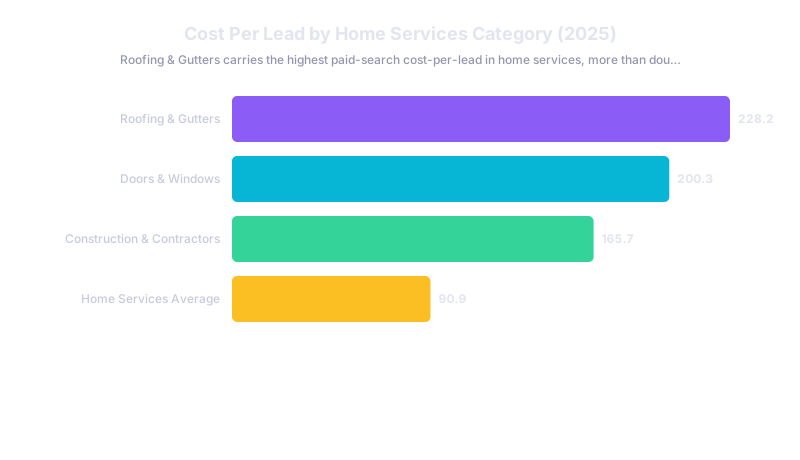
Roofing carries the most expensive paid lead in all of home services: Roofing & Gutters averages $228.15 per lead, more than double the $90.92 home-services average (LocaliQ, 2025). When a hail storm rolls through, every roofer in town opens their ad budget at the same moment, and that already-expensive lead gets bid even higher. The contractors who profit through storm season are the ones who built their visibility in the quiet months and treat paid ads as a throttle, not an engine.
Short answer: Roofing is a high-ticket, high-competition trade where paid leads are the priciest in home services: Roofing & Gutters averages $228.15 per lead versus $90.92 across home services overall (LocaliQ, 2025). Storm season multiplies demand but also spikes ad costs, because every local roofer bids at once. The winners build a year-round foundation, local SEO, an optimized Google Business Profile, reviews, and fast lead response, then layer paid search and Local Services Ads on top when a storm hits, instead of buying every lead at peak price.
Roofing Is a High-Ticket, High-Competition Lead Game
Start with the number that shapes every roofing marketing budget. In LocaliQ's 2025 Home Services Search Advertising Benchmarks (data covering April 2024 to March 2025), Roofing & Gutters posted the highest cost-per-lead of any home services category at $228.15, against a $90.92 average across all home services. The category also ran a 3.70% conversion rate and a $10.70 average cost-per-click. Roofing is not just expensive to advertise, it is the most expensive trade in the entire home-services set.
That cost sits inside a large, fragmented market. IBISWorld values the US roofing contractors industry at $92.5 billion in 2026, after a 5.0% compound annual growth rate from 2021 to 2026. "Fragmented" is the key word for your marketing: most of the competition you're bidding against is other local roofers, not national brands. The auction you're fighting in is hyper-local.
Here's why the painful CPL still works. A single roof replacement is a five-figure job. One signed job can pay back dozens of leads, which is exactly why the math is different from cheaper trades where a $228 lead would be ruinous. The metric that actually matters isn't cost-per-lead at all, it's cost-per-acquired-customer. A $228 lead that closes at 25% costs you roughly $912 per signed roof, which is fine on a job worth many multiples of that. A $90 lead that never closes costs you infinity. Optimize for signed jobs, not cheap clicks.
The Storm-Season Surge and Why It Spikes Your Costs
Storm demand is real, sudden, and largely insurance-funded. To grasp the scale: State Farm alone paid out over $3.5 billion in hail claims in 2022, up more than $1 billion from 2021 (Insurance Information Institute, citing State Farm). When hail hits a metro, thousands of homeowners file claims within days, and every one of them becomes a roofing lead more or less overnight.
The competition for those leads is intensifying, not easing. In Roofing Contractor's 2026 State of the Roofing Industry Report, 78% of contractors expect sales volumes to increase in 2026, and 89% expect sales to grow over the next three years. That optimism translates directly into ad spend, more roofers chasing the same storm-hit zip codes. As Kayhan Fatemi, Executive Vice President at Best Contracting Services, put it in the report: "The consensus is, essentially, that 2026 is going to be stable, but uncomfortable because of all the uncertainties out there."
The trap is straightforward. In the 48 to 72 hours after a major hail event, every local roofer raises Google Ads budgets simultaneously. That already-high $228.15 CPL climbs even further, because paid search is a live auction and demand-side competition just spiked. If storm week is the first time you show up, you're buying the most expensive version of the most expensive lead in home services. The practical takeaway: storm season is when you harvest demand you already rank for, not when you start building visibility from scratch.
Build a Year-Round Lead Engine, Not a Storm-Chasing Scramble
The roofers who win storm season built their advantage during the calm. The foundation has four parts, and none of them spike in price when a storm hits.
- Local SEO and an optimized Google Business Profile. Organic rankings for "roofer near me," "roof repair," and "storm damage roof inspection" capture demand at near-zero marginal cost during a surge. While competitors pay $10.70 a click, you're collecting the same searchers for free. Our local SEO guide for service businesses covers the mechanics.
- A steady review system. Reviews are the trust currency of roofing, a homeowner letting a stranger onto their roof and filing an insurance claim wants proof you're legitimate. A system that generates a consistent stream of Google reviews compounds over time and outranks one-off ad blasts.
- Service-area pages. A dedicated page for each town and neighborhood you cover lets you rank for storm-hit zip codes specifically, so when hail lands on one suburb you already own the search results there.
- A website built to convert. Ranking is wasted if the site doesn't turn visitors into booked inspections. See how to turn your website into a lead generation machine for the conversion side.
Paid Search and Local Services Ads During a Storm
Paid ads still belong in your storm playbook, they're just the supplement, not the whole meal. A few rules keep them profitable when costs peak:
Budget for the spike and cap it. Expect peak CPCs and CPLs in the 48 to 72 hours after a major storm. Decide your daily cap in advance and hold it, rather than chasing every click as the auction heats up. If you can't afford to buy every lead, don't try, buy the ones your capacity can actually service.
Prioritize Local Services Ads. Google Local Services Ads run on a pay-per-lead model with the Google Guaranteed badge, and they frequently deliver cheaper, higher-intent roofing leads than standard search ads. Because you pay per lead rather than per click, and the badge carries built-in trust, LSAs often outperform search during a surge. If you're weighing where dollars go, our breakdown of Google Ads vs SEO for local business frames the trade-offs.
Geo-target the actual storm footprint. Don't blanket your whole metro. Point tight geo-targeting at the specific zip codes the storm actually hit. Homeowners three towns over didn't get hail and aren't buying, so paying to reach them just inflates your CPL.
Track by booked job, not lead volume. A storm produces a flood of leads, and plenty are low quality, tire-kickers, price-shoppers, and people whose damage doesn't meet a deductible. Measuring by lead count makes a bad week look great. Measure by inspections booked and jobs signed, so a spike of junk leads doesn't distort your numbers or your budget decisions.
Speed to Lead Wins the Roof
After a storm, homeowners don't call one roofer, they call several, often from the same Google search. The first credible company to respond frequently wins the inspection, before competitors even return the voicemail. Speed to lead is not a nice-to-have in roofing, it's the deciding factor.
The silent leak is the missed call. During a surge, call volume overwhelms a small office, crews are on roofs, the phone rings all day, and after-hours calls go nowhere. Every unanswered call is a lead you already paid $228 to generate, handed straight to whoever picks up next. The office you can't staff up fast enough is exactly where storm-week revenue quietly disappears.
The fix doesn't require hiring a call center. AI answering and instant follow-up tools let a small crew respond in minutes, capturing after-hours calls, texting back missed callers automatically, and booking inspections while the homeowner is still shopping. See AI answering for missed calls for how a two-person office covers a storm-week call spike without adding headcount. Responding in two minutes instead of two hours is often worth more than any bid adjustment.
Get Found by AI Search (GEO for Roofers)
Homeowners increasingly ask ChatGPT and Google AI Overviews "who's a good roofer near me?" before they ever run a traditional search. Being the roofer those tools recommend is a new front in lead generation, and it rewards the same year-round work as local SEO.
What moves the needle is being mentioned across the web, not just being linked to. Ahrefs analyzed 75,000 brands and found that brand web mentions correlate with AI Overview visibility at 0.664, far above backlinks at 0.218 (Ahrefs, "AI Overview Brand Visibility Factors," May 2025). For a roofer, that means local citations, directory listings, community coverage, and consistent mentions of your name across your service area matter more than chasing links.
On-page tactics help too. In the "GEO: Generative Engine Optimization" study (Aggarwal et al., ACM KDD 2024), adding quotations was the single top-performing method, lifting visibility roughly 40% on the study's position-adjusted word-count metric, with adding statistics close behind at about 33%, and citing sources delivering as much as a 115% gain for a lower-ranked page. Notably, old-school keyword stuffing produced a negative result, tactics that worked in search engines can backfire in generative ones. One caveat: these figures come from a synthetic academic benchmark, not from live local-roofer queries, so treat "up to 40%" as directional rather than a guarantee. The through-line is clear: cite real sources, back claims with real numbers, and keep publishing genuine local content.
What This Means for Your Business
Roofing leads are expensive by nature, and no tactic will make a $228 lead cheap. So stop optimizing for the cheapest lead and start optimizing for the lowest cost-per-signed-job. That single reframe changes every budget decision you make.
Win before the storm. Rank for your service areas, stack Google reviews, publish local content that AI tools can cite, and be the roofer who answers in two minutes instead of two hours. Do that year-round, and paid search and Local Services Ads become a throttle you open when hail hits, a supplement to demand you already earned, not a lifeline you're scrambling to build mid-surge. Treat storm season as the harvest, not the planting.
The roofers who overpay are the ones who only start marketing after the hail. The ones who profit built the boring foundation in the quiet months, so when the storm comes, they're already the answer homeowners find first.
Storm season shouldn't decide your year. Semark builds year-round roofing lead systems, local SEO, reviews, fast lead response, and paid ads that scale with the weather. See our roofing marketing at /industries/home-services/roofing or book a strategy call at /contact.