
Are AI Agents Real? Only 16% Are - the Rest Is Marketing
Only 16% of enterprise AI deployments actually qualify as "true agents" - most are fixed-sequence workflows wrapped around a single model call (Menlo Ventures, 2025). The word "agent" is now on nearly every vendor's homepage, but the product behind it usually is not one.
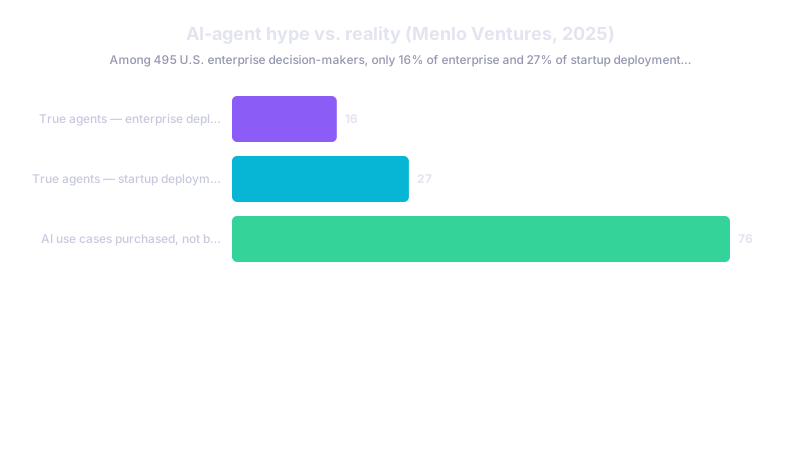
Short answer: AI agents are real, but rare. In a survey of 495 U.S. enterprise decision-makers, only 16% of deployments met the technical definition of an agent - a system where the AI plans, takes actions, checks the results, and adapts (Menlo Ventures, 2025). The other 84% were scripted workflows or chatbots that vendors relabeled "agentic" for marketing. For a small business, most tools sold to you as "AI agents" today are really smart automations - and that is fine, as long as you do not pay agent prices for chatbot capabilities.
What actually counts as an "AI agent"
The industry has a real definition, and it is stricter than the marketing. Menlo Ventures describes a true agent as a system "where an LLM plans and executes actions, observes feedback, and adapts its behavior." Everything else, the report says, is "built around fixed-sequence or routing-based workflows wrapped around a single model call" (Menlo Ventures, 2025).
In plain terms: a real agent is given a goal, figures out the steps itself, uses tools (your calendar, CRM, or a payment system), notices when something goes wrong, and tries a different approach. A chatbot follows a script you wrote and answers within it. A workflow runs the same fixed steps every time. Both are useful. Neither is an "agent" in the sense the demos imply. If you want the honest baseline version of this technology for a small business, our guide on what AI agents are and how small businesses can use them walks through it without the hype.
Why the label is mostly marketing
The 16% figure comes from enterprises - large companies with data teams and real budgets. Even among AI-native startups, only 27% of deployments qualified as true agents (Menlo Ventures, 2025). If the most technically sophisticated buyers in the market are shipping "agents" only about one time in six, the "agent" badge on a $49-per-month small business tool is almost certainly describing something simpler underneath.
This matters because the pricing and the promise travel with the label. "Agent" implies autonomy - hire it once and it handles the whole job. In practice you are usually buying a guided workflow that still needs a human to define the steps, catch the errors, and approve the output. That is a worthwhile product. It is just not the self-driving employee the word suggests.
Companies are buying, not building - and it is basic under the hood
Two more findings from the same report puncture the "custom autonomous agent" story. First, the build-versus-buy math flipped: 76% of enterprise AI use cases are now purchased rather than built in-house, up from a near-even 47% built / 53% bought split in 2024 (Menlo Ventures, 2025). "AI is fundamentally rewiring how enterprises buy software," said Joff Redfern, a partner at Menlo Ventures. Companies with the resources to build their own agents are increasingly choosing not to.
Second, the customization inside real deployments is modest. Menlo found that "prompt design remains the dominant technique, followed by retrieval-augmented generation (RAG)," while "more advanced approaches - fine-tuning, tool calling, context engineering, and reinforcement learning - are still niche" (Menlo Ventures, 2025). The exotic engineering that "agentic" marketing implies is the exception, not the rule, even at the high end.
What "agent" realistically means for a small business
Keep two numbers in mind before you buy. Only about 17% to 20% of U.S. businesses use AI at all, and under 20% of firms with four or fewer employees do - versus 37% of firms with at least 250 employees (U.S. Census Bureau, 2026). The AI economy you read about is largely a big-company story. As a small operator, you are not behind for lacking an "agent"; you are in the majority.
And the payoff, where it shows up, is efficiency rather than a revenue windfall. Deloitte found that 66% of organizations report productivity and efficiency gains from AI, but only 20% are actually growing revenue with it today - even though 74% hope to (Deloitte, 2026). An honest agent pitch should promise you saved time, not a bigger top line. If a vendor promises the top line, treat it as a red flag.
How to tell a real agent from a rebranded chatbot
Before you sign, ask the vendor four questions:
| Ask this | A real agent | A relabeled chatbot / workflow |
|---|---|---|
| Can it use my tools and take actions? | Yes - books, updates, sends, with permission | Only answers or hands off to a human |
| What happens when a step fails? | It notices and retries a different way | It errors, stalls, or gives a wrong answer confidently |
| Who defines the steps? | The system plans them from the goal | You script every step in advance |
| Do I still need to review its work? | For high-stakes actions, yes - always | Yes, constantly |
What This Means for Your Business
"Are AI agents real?" Yes - for about 16% of enterprise deployments (Menlo Ventures, 2025). For nearly everyone else, and for almost every small business tool on the market today, "agent" is a marketing word attached to a chatbot or a fixed workflow. That is not a reason to avoid AI. It is a reason to buy the honest version: name the specific task you want handled, ask the four questions above, and expect efficiency gains rather than new revenue. The build-versus-buy data says even sophisticated companies are buying ready-made tools rather than building autonomous agents (Menlo Ventures, 2025), so you are in good company keeping it simple. When you are deciding whether a task warrants automation at all, our piece on when to automate versus when to hire is a good gut check.
If you want a straight answer on whether a specific "AI agent" tool will actually do the job you have in mind - or whether a cheaper automation would do it better - talk to us or see how we approach AI and machine learning for small and mid-market businesses. We will tell you when the simpler tool is the smarter buy.
Scrub changelog
- kept-verified: Menlo Ventures: 16% enterprise / 27% startup true agents; agent definition ('LLM plans and executes actions, observes feedback, and adapts'); 'fixed-sequence or routing-based workflows wrapped around a single model call'; survey of 495 U.S. decision-makers Nov 7-25, 2025. - Re-fetched menlovc.com this session; every figure, the definition wording, and the survey methodology match exactly.
- kept-verified: Menlo Ventures: 76% of enterprise AI use cases purchased vs 47% built / 53% bought in 2024; prompt design dominant, then RAG; fine-tuning, tool calling, context engineering, reinforcement learning still niche. - Re-fetched menlovc.com this session; build/buy split and customization-technique hierarchy confirmed verbatim.
- kept-verified: Joff Redfern quote 'AI is fundamentally rewiring how enterprises buy software' and his title (Partner at Menlo Ventures). - Re-fetched GlobeNewswire press release this session; exact quote and title confirmed.
- kept-verified: U.S. Census Bureau: overall AI usage 17-20%; under 20% for firms with four or fewer employees; 37% for firms with 250+ employees. - Re-fetched census.gov BTOS story this session; all three figures confirmed verbatim (survey window Dec 14 2025 - May 3 2026).
- kept-verified: Deloitte: 66% report productivity/efficiency gains, 20% currently increasing revenue, 74% hope to; 3,235 leaders, Aug-Sep 2025. - Re-fetched this session against Deloitte's primary report page (deloitte.com/.../state-of-ai-in-the-enterprise.html), which states verbatim: "two-thirds (66%) of organizations reporting gains" and "74% of organizations hoping to grow revenue ... compared to just 20% that are already doing so," plus "surveyed 3,235 leaders between August and September 2025." Reference URL updated from the press-release page (which did not surface the three percentages) to this primary report page.