
Fewer than one in five US firms with four or fewer employees are using AI, while 37% of firms with at least 250 employees are (US Census Bureau, Business Trends and Outlook Survey, 2026). If you run a small or mid-sized business and you're shopping for an AI development company to close that gap, the hard part isn't finding a vendor - it's telling a real engineering partner apart from a slide deck. This guide gives you 12 questions that do exactly that.
Short answer: Choose an AI development company the way you'd hire a contractor for your house: make them prove the work, not just describe it. Ask to see a working evaluation (not a demo), get data and output ownership in writing, confirm whether they're building something custom or reselling a chatbot, and insist on a clear exit plan. The best signal isn't how advanced the technology sounds - it's how honestly they talk about what AI can't do.
1. "Can you show me a working eval, not just a demo?"
A demo is a magic trick: the vendor controls the input, so the output always looks great. An evaluation - an "eval" in the trade - is a repeatable test that runs the AI against a fixed set of real, messy examples and scores how often it gets them right. Any company serious about AI development runs evals continuously, because a large language model that answers 9 out of 10 questions correctly in a demo can quietly answer 6 out of 10 correctly on your actual customer emails.
Ask them to build a small eval on your data before you sign: 30 to 50 real examples, scored in front of you. A vendor who can't or won't do this is selling you the demo, not the system.
2. "Who owns the data, the outputs, and anything you fine-tune?"
Ownership is where AI contracts differ most from ordinary software, because there are three separate things to own: the data you put in, the outputs the model generates, and any derived assets - a fine-tuned model, embeddings, or a labeled training set - that you paid to create. Get all three assigned to you in the contract, in plain words. Watch for a clause that lets the vendor train its own models on your data, and for outputs you can't export in a usable format when you leave. Whatever you can't take with you becomes the vendor's leverage on renewal day.
3. "Are you building something custom, or reselling a wrapper around ChatGPT?"
There's nothing wrong with building on top of a foundation model - nearly everyone does. The problem is paying custom-development prices for a thin wrapper you could have configured yourself. In real enterprise deployments, the dominant customization technique is simple prompt design, with retrieval-augmented generation (RAG) - feeding the model your documents so it answers from your knowledge - a distant second; fine-tuning and reinforcement learning remain niche, used mainly by frontier teams (Menlo Ventures, State of Generative AI in the Enterprise, December 2025).
The lesson for buyers: most production AI is configuration and retrieval, not exotic model training. If a vendor leads with "we'll fine-tune a custom model for you," ask why a well-designed prompt plus your own documents wouldn't do the same job for a fraction of the cost. Our guide to the best AI tools for small business in 2026 covers what you can often set up yourself first.
4. "Is this actually an 'agent,' or just a marketing label?"
"AI agent" is the most abused word in the industry. A true agent decides its own next step and can take actions; most systems sold as "agents" are fixed, scripted workflows with a language model bolted on. Only 16% of enterprise AI deployments qualify as true agents - most are fixed-sequence workflows (Menlo Ventures, 2025). That's not a criticism of scripted workflows; they're often more reliable and cheaper. It is a reason to not pay an "autonomous agent" premium for an if-this-then-that automation. Read what AI agents really are and how small businesses can use them before this conversation.
5. "How will we measure ROI - efficiency or revenue?"
Be clear-eyed about what AI actually delivers today. Among enterprises adopting AI, 66% report productivity and efficiency gains, but only 20% say they're already growing revenue from it, while 74% merely hope to (Deloitte, State of AI in the Enterprise, 2026, n=3,235). AI is, overwhelmingly, a cost-and-time saver right now, not a revenue engine.
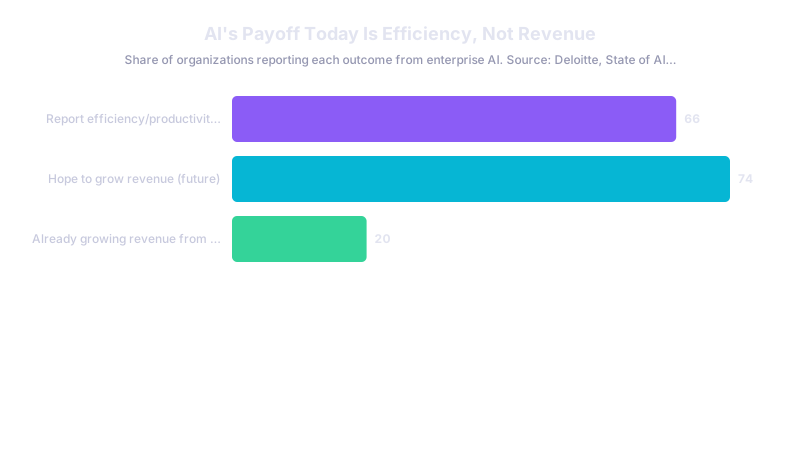
A good AI development company will define your success metric in the first meeting - hours saved per week, response time cut, tickets deflected - and build a way to measure it. A vendor who promises revenue growth without a measurement plan is selling hope.
6. "Should we build this at all - or just buy an off-the-shelf tool?"
Among large enterprises, 76% of AI use cases are now purchased rather than built in-house, a sharp reversal from 2024, when 47% were built internally and 53% purchased (Menlo Ventures, 2025). That's enterprise data - but the lesson runs stronger for a small business: if a $30-a-month tool already does the job, custom development is the wrong first move. An honest AI partner will tell you when to buy instead of build, even though it costs them the project. Our piece on AI versus hiring an employee works through the same buy-build-hire tradeoff.
7. "What happens when the underlying model changes?"
Foundation models are updated, repriced, deprecated, and replaced constantly, and a system tuned to one model's quirks can degrade overnight when that model changes. (Because model lineups and prices shift so fast, treat any specific model name or per-token price a vendor quotes as something to re-verify at the provider's live pricing page, not a fixed guarantee.) Ask how they'll handle a model swap: Can they switch providers without rewriting everything? Do they re-run their evals after every model update? A mature vendor has a plan; a fragile one has a system silently pinned to a single model version.
8. "Can we leave? What do we keep if we walk in month four?"
Run this thought experiment out loud with the vendor: it's month four, it isn't working, and you want out. What do you keep? If the honest answer is "nothing you can use without us," you're not buying a tool - you're renting a dependency, and the price of that dependency is set on renewal day. Insist on data export in a standard format, documentation, and no punitive exit terms before you sign. The red flags for hiring any outside agency apply here almost word for word.
9. "Who is accountable when the AI gets it wrong?"
AI systems make confident mistakes. Ask who reviews outputs, how errors are caught, and what the escalation path is when the model is wrong in front of a customer. For regulated work this is non-negotiable. A serious vendor talks openly about guardrails, human review, and failure handling; a weak one insists the model is simply accurate. The difference between those two answers tells you more than any benchmark score.
10. "What will this actually cost to run - including usage and maintenance?"
The build price is only part of the bill. AI systems carry ongoing costs: per-use charges from the model provider (usually billed per unit of text processed), monitoring, and maintenance as models and your needs change. Ask for a realistic monthly operating estimate at your expected volume, and for what happens to the bill if usage triples. Our AI chatbot cost guide for small business breaks down where these ongoing charges come from so the estimate you get is easy to sanity-check.
11. "Do you understand my industry and its compliance rules?"
Generic AI advice gets dangerous fast in regulated fields. A healthcare practice has HIPAA obligations; a law firm has confidentiality and privilege duties. Ask for specific, named experience in your sector and how they've handled its rules before. If you're in a regulated space, start from our healthcare and legal industry pages so you know which questions carry legal weight.
12. "Can you prove past results with references I can call?"
You've probably seen the headline that "95% of AI projects fail." That number traces back to a single preliminary, non-peer-reviewed report built on roughly 52 interviews and about 150 survey responses, which its own authors called "directionally accurate based on individual interviews rather than official company reporting" (MIT NANDA, State of AI in Business 2025). Treat it as a caution, not a law of nature - plenty of AI projects work. But it's a fair reminder to demand proof: named references you can phone, a case with real before-and-after numbers, and a candid account of a project that didn't work and what they learned. A vendor who has never had a project struggle either hasn't done many, or isn't being straight with you.
What This Means for Your Business
Choosing an AI development company is a due-diligence problem, not a technology problem. The strongest signal across all 12 questions is honesty: a good partner shows you a working eval, puts ownership in writing, tells you when to buy instead of build, measures a concrete metric, and talks openly about what can go wrong. The data backs a humble posture - AI is delivering efficiency far more than revenue (Deloitte, 2026), true "agents" are rare (Menlo Ventures, 2025), and adoption among the smallest firms is still under 20% (US Census Bureau, 2026). Any vendor promising a revolution should raise your guard, not lower it.
Print these 12 questions and bring them to every sales call. The right partner will welcome them.
If you'd like a straight, no-hype assessment of whether custom AI even makes sense for your business - and what to build versus buy - talk to Semark's team or explore our AI and machine learning services.