Why Most Small Businesses Fail at SEO
SEO is not complicated. But it is misunderstood. Most small businesses fail because they:
- Chase vanity keywords they will never rank for
- Focus on tricks instead of fundamentals
- Give up after 2 months because they expected overnight results
- Hire someone who "does SEO" but cannot explain their strategy
How Search Engines Work (The 60-Second Version)
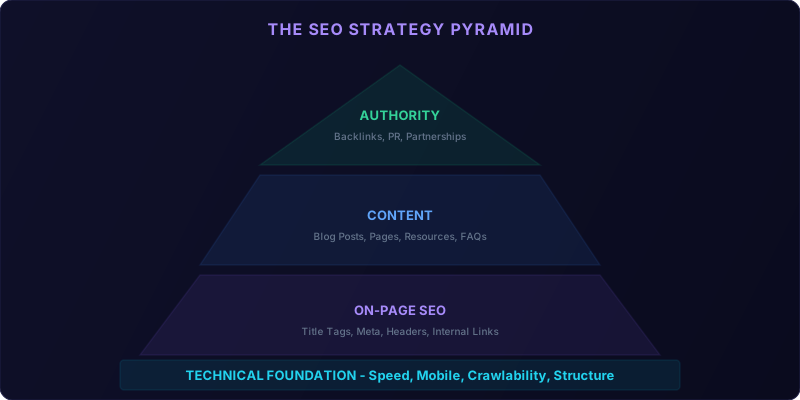
Google's job is to show the best answer for every search query. To do that, it:
- Crawls - Sends bots to discover and read your web pages
- Indexes - Stores and organizes the content it finds
- Ranks - Decides which pages to show first for each query
Phase 1: Technical SEO (Fix the Foundation)
Before writing a single word of content, make sure your website is technically sound. Think of it as fixing the plumbing before decorating the house.
The Essential Technical Checklist
Speed and Performance:
- Page loads in under 3 seconds on mobile
- Images are compressed and served in modern formats (WebP, AVIF)
- No render-blocking JavaScript or CSS
- Core Web Vitals passing (LCP under 2.5s, INP under 200ms, CLS under 0.1)
- XML sitemap exists and is submitted to Google Search Console
- Robots.txt is not accidentally blocking important pages
- No orphan pages (every page is linked from at least one other page)
- Clean URL structure (example.com/services/seo, not example.com/?p=123)
- Fully responsive design - not just "works on mobile" but "designed for mobile first"
- No horizontal scrolling, tiny text, or hard-to-tap buttons
- Mobile page speed is as fast as desktop
- HTTPS everywhere (SSL certificate installed and active)
- No mixed content warnings
- LocalBusiness schema for your business info
- Article schema for blog posts
- FAQ schema where relevant
- BreadcrumbList schema for navigation
Phase 2: Keyword Research (Find What People Actually Search)
Here is a keyword prioritization framework:
| Priority | Volume | Difficulty (KD) | Intent | Action |
|---|---|---|---|---|
| 1 - Quick wins | 100-500 | Under 20 | Commercial | Target immediately |
| 2 - Growth keywords | 500-2,000 | 20-40 | Informational | Build content clusters |
| 3 - Competitive targets | 2,000-10,000 | 40-60 | Mixed | Target after building authority |
| 4 - Aspirational | 10,000+ | 60+ | Broad | Long-term pillar content |
| Skip | Any | 80+ | Navigational | Not worth pursuing for new sites |
Step 1: Brainstorm Seed Keywords
Start with what your customers search for:- Your services + location ("web development agency Dallas")
- Problems you solve ("website not generating leads")
- Questions they ask ("how much does digital marketing cost")
Step 2: Expand with Tools
Use free and paid tools to find related keywords and search volume:- Google Search Console (free) - Shows what you already rank for
- Google Keyword Planner (free) - Search volume estimates
- Ubersuggest (free tier available) - Keyword ideas and competition data
- Ahrefs or SEMrush (paid) - The industry standard for keyword research
Step 3: Evaluate and Prioritize
For each keyword, consider:- Search volume - How many people search for this monthly?
- Keyword difficulty (KD) - How hard is it to rank? (0-100 scale)
- Search intent - Are they looking to learn, compare, or buy?
- Relevance - Can you actually serve this person?
Step 4: Map Keywords to Pages
Every target keyword should have one page on your site optimized for it. Create a simple spreadsheet:| Keyword | Volume | KD | Target Page | Status |
|---|---|---|---|---|
| digital marketing small business | 1,900 | 38 | /blog/complete-guide | Written |
| web development cost | 1,300 | 25 | /blog/website-cost | Written |
| local SEO service business | 880 | 22 | /blog/local-seo-guide | Planned |
Phase 3: On-Page SEO (Optimize Every Page)
On-page SEO means making each page the best possible result for its target keyword.
The Essentials for Every Page
Title tag - Include the primary keyword naturally. Keep under 60 characters. Example: "How Much Does a Website Cost for Small Business? (2026 Guide)"
Meta description - Compelling summary with the keyword. Under 155 characters. This is your ad copy in search results.
URL - Short, descriptive, includes the keyword. Good: /blog/website-cost-small-business Bad: /blog/2026/03/24/post-id-847
H1 heading - One per page, matches the topic, includes the keyword.
Subheadings (H2, H3) - Organize content logically. Include related keywords naturally.
Content quality - Comprehensive, well-written, and genuinely helpful. Thin content does not rank.
Internal links - Link to related content on your site. This helps Google understand your site structure and keeps users engaged.
Images - Compressed, with descriptive alt text that includes keywords where natural.
Your website is the foundation of your SEO. If it is slow, outdated, or poorly built, even great content will struggle to rank. Make sure your site is ready with our web development services guide, and check whether a website redesign is overdue.
Phase 4: Content Strategy (The Ranking Engine)
Content is how you rank for keywords, build topical authority, and attract links.
The Pillar-Cluster Model
Organize your content into topic clusters:
Pillar page - A comprehensive guide covering a broad topic (like this article). Typically 3,000-5,000 words.
Cluster content - Specific articles that cover subtopics in depth. Each links back to the pillar and to related clusters.
Example:
- Pillar: "SEO Strategy Guide" (this article)
- Cluster: Local SEO guide
- Cluster: Technical SEO audit
- Cluster: Google Business Profile guide
- Related: SEO in 2026
Content Types That Rank
- How-to guides - "How to do X" (educational intent)
- Listicles - "10 best tools for X" (comparison intent)
- Comparison articles - "X vs Y" (decision intent)
- Cost/pricing articles - "How much does X cost" (commercial intent)
- Pillar guides - Comprehensive resources (authority building)
Publishing Cadence
Consistency matters more than volume. For a small business:
- Minimum: 2 articles per month
- Ideal: 1 article per week
- Focus on quality - One excellent 2,500-word article beats five mediocre 500-word posts
Phase 5: Local SEO (Dominate Your Area)
If you serve a specific geographic area, local SEO is your fastest path to results.
Google Business Profile
Your Google Business Profile (GBP) is arguably more important than your website for local searches. It drives the map pack results that appear above organic listings.
Optimization essentials:
- Complete every field (business name, address, phone, hours, categories)
- Add 20+ high-quality photos
- Write a keyword-rich business description
- Post weekly updates
- Collect and respond to reviews (aim for 50+ five-star reviews)
Local Citations
List your business on:
- Google Business Profile
- Bing Places
- Apple Maps
- Yelp
- Industry-specific directories
- Local chamber of commerce
- Better Business Bureau
Local Content
Create content targeting your service areas:
- City-specific service pages
- Local case studies
- Community involvement posts
- "Best [service] in [city]" content
Want a custom SEO roadmap for your business? Book a free SEO strategy call and we will identify your highest-impact opportunities.
Phase 6: Link Building (Earn Authority)
Backlinks - links from other websites to yours - are one of Google's top ranking factors. But not all links are equal.
Links That Matter
- Links from high-authority, relevant websites
- Links from local news sites, industry blogs, and directories
- Links earned naturally because your content is genuinely useful
How to Earn Links as a Small Business
- Create linkable content - Original research, comprehensive guides, tools, and infographics
- Guest posting - Write articles for industry publications with a link back to your site
- Local PR - Sponsor events, participate in community activities, get mentioned in local news
- Directory listings - Relevant, quality directories (not spammy ones)
- Broken link building - Find broken links on relevant sites and offer your content as a replacement
- HARO / media outreach - Respond to journalist queries as a subject matter expert
Links to Avoid
- Purchased links from link farms
- Links from irrelevant websites
- PBN (private blog network) links
- Excessive reciprocal link exchanges
Phase 7: Generative Engine Optimization (GEO)
In 2026, SEO is no longer just about Google's traditional search results. AI-powered search tools - ChatGPT, Perplexity, Google AI Overviews - now answer queries directly, often citing sources.
How to optimize for AI search:
- Structure content with clear questions and direct answers
- Use authoritative, factual language with cited sources
- Build topical authority (AI tools cite websites they trust across a topic)
- Provide unique data, insights, and expert perspectives (AI cannot cite generic content)
Measuring SEO Success
Metrics That Matter
- Organic traffic - Total visitors from search engines (GA4)
- Keyword rankings - Positions for your target keywords
- Organic conversions - Leads and sales from organic visitors
- Click-through rate (CTR) - Percentage of impressions that result in clicks (Search Console)
- Domain authority/rating - Overall site authority score (Ahrefs, Moz)
Timeline Expectations
- Month 1-2: Technical fixes, content planning, no ranking changes
- Month 3-4: New content indexed, early rankings for low-competition keywords
- Month 5-6: Noticeable traffic growth, some page-one rankings
- Month 7-12: Compound growth, rankings for more competitive terms
- Year 2+: Significant organic traffic, lower customer acquisition costs
For context on how SEO compares to paid ads, read Google Ads vs SEO: where to spend your first $1,000.
Common SEO Mistakes to Avoid
Here is a month-by-month SEO progress benchmark for a new website:
| Month | Expected Progress | Key Activities |
|---|---|---|
| 1 | No ranking changes | Technical audit, fix issues, keyword research |
| 2 | Indexed pages increasing | Publish 4+ articles, set up Search Console |
| 3 | Long-tail rankings appearing (page 2-3) | Continue publishing, start link building |
| 4 | Some page-1 rankings for low-KD terms | Optimize existing content, build citations |
| 5 | Organic traffic noticeably increasing | Publish pillar content, guest post outreach |
| 6 | 50-100% organic traffic growth | Update and expand top-performing content |
| 9 | Ranking for medium-competition keywords | Content refresh, advanced link building |
| 12 | Significant organic traffic and leads | Full content flywheel running, compounding growth |
- Targeting impossible keywords - A new site will not rank for "digital marketing" (KD 90+). Start with long-tail keywords.
- Ignoring search intent - If someone searches "what is SEO," they want an explanation, not a sales page.
- Neglecting technical SEO - Great content on a slow, broken website will not rank.
- No internal linking - Every page should link to related content. Orphan pages get ignored.
- Inconsistent effort - Publishing 10 articles in month one and zero in months two through six wastes your initial momentum.
- Chasing algorithm updates - Focus on creating genuinely useful content. Google's goal has never changed: show the best result for every query.
Your 90-Day SEO Action Plan
Week 1-2: Run a technical audit and fix critical issues Week 3-4: Complete keyword research and content mapping Month 2: Publish 4 articles targeting your highest-priority keywords, optimize existing pages Month 3: Continue publishing, start local SEO (GBP optimization, citations), begin link building outreach
Review your Google Search Console data monthly and adjust your strategy based on what is working.
Need help building an SEO strategy for your business? Explore our SEO services or schedule a free consultation to discuss your goals.
Frequently Asked Questions
Can I do SEO myself? Yes for basics like keyword research, content, and Google Business Profile. Technical SEO may need a professional.
What is the fastest way to rank on Google? Target low-competition long-tail keywords with comprehensive, high-quality content and strong on-page SEO.
How many blog posts do I need to rank? Quality over quantity. One excellent 2,500-word article outperforms five thin 500-word posts every time.
Is SEO a one-time thing? No. SEO requires ongoing content creation, technical maintenance, and link building to maintain rankings.
What are the most important ranking factors in 2026? Content quality, backlinks, page experience (Core Web Vitals), and topical authority remain the top factors.